About the Author: Knight is an aviation professional with extensive experience in airport operations and aviation career development. He specializes in helping aspiring aviation professionals understand career paths, salary expectations, and advancement opportunities. His expertise comes from working directly with aviation employers and industry professionals. Kinght’s mission is to make complex aviation career information accessible to everyone interested in the aviation industry.
Introduction
The aviation industry offers some of the most lucrative career opportunities available today. Whether you’re considering a career change or just starting your professional journey, understanding which aviation roles offer the highest compensation is essential for making informed decisions. The aviation sector employs hundreds of thousands of professionals worldwide, from pilots to airport managers to maintenance technicians, and compensation varies dramatically depending on the specific role, experience level, and location.
This comprehensive 2026 salary guide examines the highest-paying positions in aviation, exploring not just base salaries but also benefits, bonuses, and long-term earning potential. We’ll look at roles across different aviation sectors—commercial airlines, airports, maintenance organizations, and air traffic control—to give you a complete picture of where the best compensation opportunities exist. If you’re interested in aviation as a career path, understanding these salary ranges can help you choose the right position and set realistic financial goals.
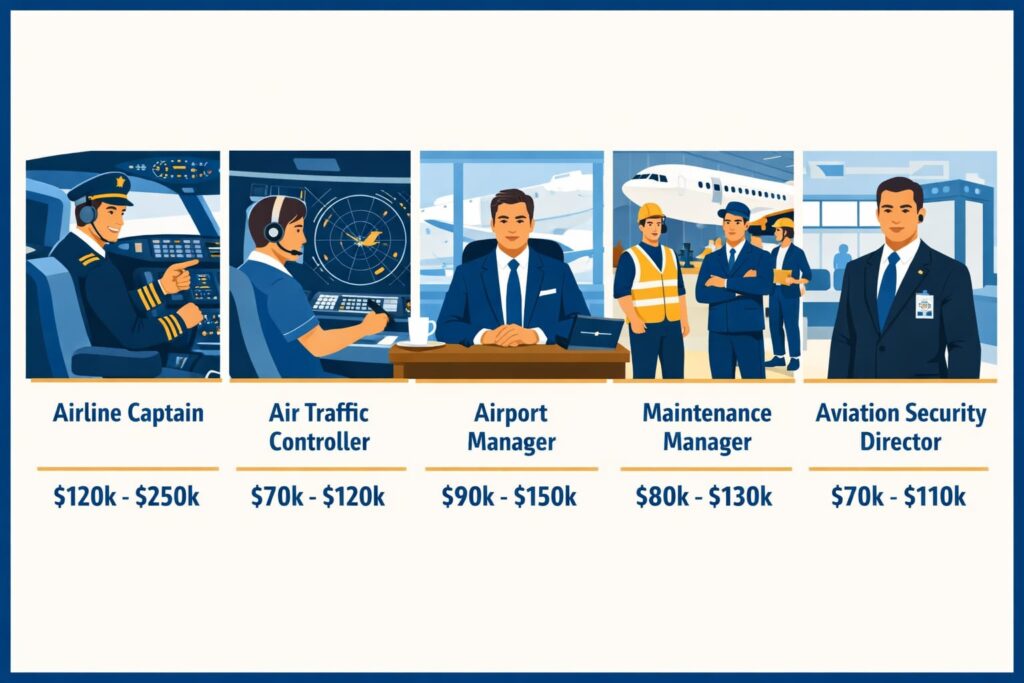
The Top 10 Highest Paying Aviation Jobs
1. Airline Pilot (Captain)
Airline pilots, particularly captains on large commercial aircraft, represent some of the highest-earning positions in aviation. According to the U.S. Bureau of Labor Statistics, commercial airline pilots earn a median salary of $147,220 annually, with experienced captains at major airlines like Delta, United, or American Airlines earning significantly more. Senior captains at large carriers typically earn $180,000 to $250,000 per year, with some earning even higher when including flight bonuses and per diem allowances.
The path to becoming a captain is lengthy, typically requiring 10-15 years of progressive experience starting as a first officer. However, once you reach captain status, earning potential is exceptional. Additionally, airline pilots receive comprehensive benefits including health insurance, retirement plans with matching contributions, generous vacation time, and airline travel privileges for the employee and immediate family.
2. Air Traffic Control Manager
Air traffic control managers oversee the operations of control towers and radar facilities, managing air traffic controllers and ensuring safe and efficient operations. According to the Bureau of Labor Statistics, air traffic control managers earn a median salary of approximately $127,000 annually, with experienced managers at major facilities earning $150,000 to $180,000 per year.
These positions require extensive experience—typically 10+ years as an air traffic controller before advancement to management. However, the compensation reflects the critical responsibility of these roles. For more details on how to become an air traffic controller, see our complete career guide on becoming an ATC.
3. Commercial Airline First Officer
First officers, also known as co-pilots, work alongside captains and typically earn between $120,000 and $180,000 annually depending on experience and airline. At major carriers, first officers with 8+ years of experience can earn close to captain salary. Most first officers advance to captain positions within 10-15 years, making this a gateway to even higher earning potential.
4. Airport Manager
Airport managers oversee all operations at commercial airports, managing budgets of hundreds of millions of dollars and supervising hundreds of employees. According to the Bureau of Labor Statistics, airport managers earn median salaries of $95,000 to $125,000 annually. However, managers at large international airports like Atlanta, Dallas, or Los Angeles often earn $150,000 to $200,000 per year.
These positions require typically 10-15 years of progressive experience in airport operations, starting with ground handling roles and advancing through supervisory positions. For detailed information about this career path, see our guide on Aviation careers guide.
5. Airline Operations Manager
Airline operations managers oversee flight scheduling, crew management, maintenance coordination, and overall airline operations. These positions typically pay $100,000 to $160,000 annually depending on the airline and experience level. Major carriers offer bonuses and profit-sharing arrangements that can significantly increase total compensation.
6. Airport Duty Manager
Airport duty managers oversee all operational activities during a specific shift at commercial airports, making critical decisions affecting thousands of passengers and dozens of flights daily. These positions typically pay $85,000 to $120,000 annually depending on airport size and location. For comprehensive information about this role, see our detailed guide on airport duty manager responsibilities.
7. Maintenance Control Center Manager
Maintenance control center managers coordinate aircraft maintenance scheduling and execution, ensuring aircraft remain in service safely and efficiently. These positions typically pay $90,000 to $140,000 annually. They require extensive technical knowledge and typically 8-10 years of experience in aircraft maintenance operations.
8. Flight Service Specialist (Senior)
Senior flight service specialists provide flight planning and weather briefing services to pilots. These positions typically pay $80,000 to $130,000 annually depending on facility and experience. Senior specialists often supervise teams and manage increasingly complex responsibilities.
9. Aircraft Maintenance Manager
Aircraft maintenance managers oversee aircraft inspection, repair, and maintenance operations at airlines or maintenance organizations. These positions typically pay $85,000 to $135,000 annually. They require extensive technical knowledge of aircraft systems and typically 8-10 years of experience in maintenance roles.
10. Airport Security Manager
Airport security managers oversee all security operations at commercial airports, managing large teams and coordinating with federal agencies. These positions typically pay $80,000 to $125,000 annually depending on airport size and location. They require progressive experience in security operations and typically 10+ years of service.
Why Aviation Pays So Well
Several factors explain why aviation careers offer such competitive compensation. First, aviation is heavily regulated by federal agencies like the FAA, which creates licensing and certification requirements that limit the number of qualified professionals available. This creates supply-side pressure that increases wages. Second, aviation involves safety-critical decisions where mistakes can have catastrophic consequences, justifying higher compensation for the responsibility. Third, aviation careers often require extensive training and education—becoming a pilot requires 1,500+ flight hours, becoming an air traffic controller requires 3-4 years of specialized training, and advancing to management typically requires 10+ years of experience.
Additionally, the aviation industry operates 24/7, requiring employees to work irregular shifts, nights, weekends, and holidays, which is compensated through shift differentials and premium pay. Finally, aviation has strong unions representing pilots, air traffic controllers, and flight attendants, which has historically negotiated favorable compensation packages that set industry standards.
Factors That Influence Aviation Salaries
Several variables significantly impact earning potential in aviation careers. Experience is perhaps the most important factor—entry-level positions pay substantially less than senior roles, with 10-15 years representing a major jump in compensation. Employer size and profitability matters significantly—major carriers like Delta, United, and American Airlines typically pay more than regional carriers or non-union operators.
Geographic location influences compensation, with airports in expensive metropolitan areas (New York, Los Angeles, San Francisco) paying more than regional airports. Union status typically increases compensation and benefits, so unionized positions generally pay more than non-union equivalents. Educational background can accelerate advancement—individuals with bachelor’s degrees in aviation or business administration often advance to management faster than those without degrees.
Seniority systems prevalent in many aviation roles mean that compensation increases automatically with years of service—this creates long-term earning stability but limits early-career earning potential. Finally, specialization matters—pilots qualified to fly large international aircraft (Boeing 777, Airbus A380) earn more than those flying regional aircraft.
Benefits Beyond Base Salary
While base salary is important, total compensation packages in aviation include valuable benefits that significantly increase earning potential. Most airline pilots receive per diem allowances (typically $1.50-$2.50 per hour while away from base), which can add $15,000-$30,000 annually to base salary. Flight bonuses for international routes and premium destinations add additional compensation.
Health insurance is typically comprehensive, often including medical, dental, and vision coverage. Retirement benefits are particularly generous in unionized positions—many pilots can retire with full pensions after 30 years of service, representing lifetime income worth millions of dollars. Airline travel benefits allow employees and family members to fly standby on any airline at minimal cost, representing thousands of dollars annually in value.
Paid time off is generous, with senior pilots receiving 5-6 weeks of vacation annually. Stock purchase plans and profit-sharing arrangements at profitable airlines can add substantial additional income. When calculating true earning potential, these benefits often add 25-40% to base salary value.
Education and Training Costs vs. Long-Term Earnings
It’s important to note that reaching these high-paying positions requires substantial investment in education and training. Becoming a commercial pilot requires approximately 1,500+ flight hours, costing $150,000-$250,000 before earning a single dollar as a commercial pilot. Air traffic control training programs cost $10,000-$25,000, though many scholarships are available. Aviation management degrees cost $40,000-$120,000 depending on the institution.
However, the long-term return on investment is exceptional. A pilot earning $200,000 annually after 10 years of career development recovers training costs within 1-2 years and then accumulates substantial wealth over a 30-40 year career. This is why aviation career investment is worthwhile despite significant upfront costs.
Career Pathways to High-Paying Positions
Understanding the progression required to reach these high-paying roles helps set realistic expectations. Pilot pathway: Private pilot certificate → Commercial pilot certificate → Regional airline first officer (years 3-5) → Regional airline captain (years 8-12) → Major airline first officer (years 12-15) → Major airline captain (years 20+).
Air traffic control pathway: Complete training program → Controller at small facility (years 0-3) → Controller at medium facility (years 3-8) → Controller at large facility (years 8-15) → Facility manager/supervisor (years 15+).
Airport management pathway: Ground handling or terminal operations staff (years 0-2) → Supervisory role (years 2-5) → Duty manager or department head (years 5-10) → Airport operations manager (years 10-15) → Airport manager (years 15+).
Maintenance management pathway: Entry-level mechanic (years 0-2) → Lead mechanic/supervisor (years 2-7) → Maintenance control center or department manager (years 7-12) → Director of maintenance (years 12+).
Each pathway requires progressive skill development, increasing responsibility, and typically 10-20 years to reach the highest-paying positions. However, compensation increases significantly at each level, making the career worth the investment of time and effort.
Comparing Aviation to Other High-Paying Careers
How do aviation careers compare to other professions offering six-figure salaries? Commercial pilots earning $150,000-$250,000 compare favorably to physicians (median $208,000), dentists ($153,000), and engineers ($105,000). However, physicians typically require more education (12+ years) while pilots reach high earnings faster (8-15 years).
The benefit structure in aviation is particularly strong—pilot pensions and benefits are generally more generous than in other professions. Additionally, pilots enjoy schedule flexibility after reaching seniority levels, allowing them to bid for preferred flight schedules and time off, which many professionals in other high-paying fields cannot match.
Challenges of High-Paying Aviation Careers
While compensation is excellent, high-paying aviation positions come with significant challenges. Pilots work irregular hours including nights, early mornings, and weekends, away from family for extended periods. The physical and mental demands are substantial—pilots manage complex aircraft systems, make critical safety decisions, and endure long flights (sometimes 12-16 hours) requiring intense focus.
Air traffic controllers face extreme pressure, managing dozens or hundreds of aircraft simultaneously, with lives depending on their split-second decisions. Airport and airline managers work long hours managing complex operations and responding to crises. These careers demand exceptional dedication, continuous learning, and comfort with high-responsibility positions.
Conclusion
Aviation offers exceptional career opportunities for those willing to invest in education and training. Pilots, air traffic controllers, airport managers, and operations professionals can earn $120,000-$250,000+ annually, with benefits that significantly increase total compensation. While reaching these high-paying positions requires 10-20 years of career development and substantial upfront training costs, the long-term earning potential and career satisfaction justify the investment.
If you’re passionate about aviation and willing to commit to the necessary education and progression, these high-paying careers can provide exceptional financial security and professional fulfillment. For more information about specific aviation careers, see our guides on becoming an air traffic controller, airport management careers, and aviation ground operations careers.
Sources & References
- U.S. Bureau of Labor Statistics – Occupational Outlook Handbook (bls.gov)
- Federal Aviation Administration – Career Resources (faa.gov)
- Regional Airline Association – Pilot Compensation Data
- Air Traffic Control Association – Career Information
- Airport Council International – Airport Operations Data
Pingback: Airport Duty Manager: Salary, Responsibilities & Career Guide 2026
Pingback: "Airport Noise Management: How Airports Reduce Aircraft Noise 2026"
Pingback: Ten-Million-Dollar Career? The profession of flying: How much do pilots earn? - Avio Space