About the Author: Knight is an aviation professional with extensive experience in airport operations and aviation career development. He specializes in helping aspiring aviation professionals understand career paths, salary expectations, and advancement opportunities. His expertise comes from working directly with aviation employers and industry professionals. Kinght’s mission is to make complex aviation career information accessible to everyone interested in the aviation industry.
Introduction
Aviation offers diverse career opportunities across multiple sectors—commercial airlines, airports, cargo carriers, maintenance organizations, and support services. From pilots earning $150,000+ annually to ground handlers starting at entry-level positions, aviation employs hundreds of thousands of professionals with varied education levels and skill sets. Whether you’re searching for a lucrative pilot career, an entry-level position in ground handling, or a specialized role in aircraft maintenance, aviation has opportunities.
This comprehensive guide explores major aviation career categories, salary ranges, education requirements, and advancement opportunities. Whether you’re early in your career, considering career changes, or simply curious about aviation jobs, this guide provides the foundation for understanding what aviation careers offer.
Major Aviation Career Categories
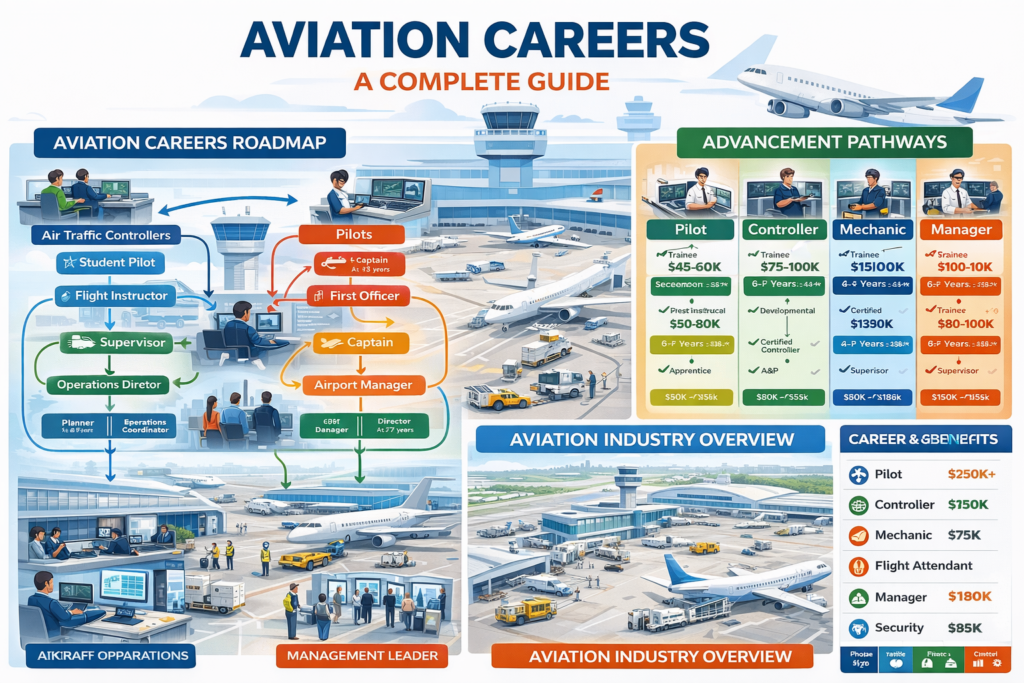
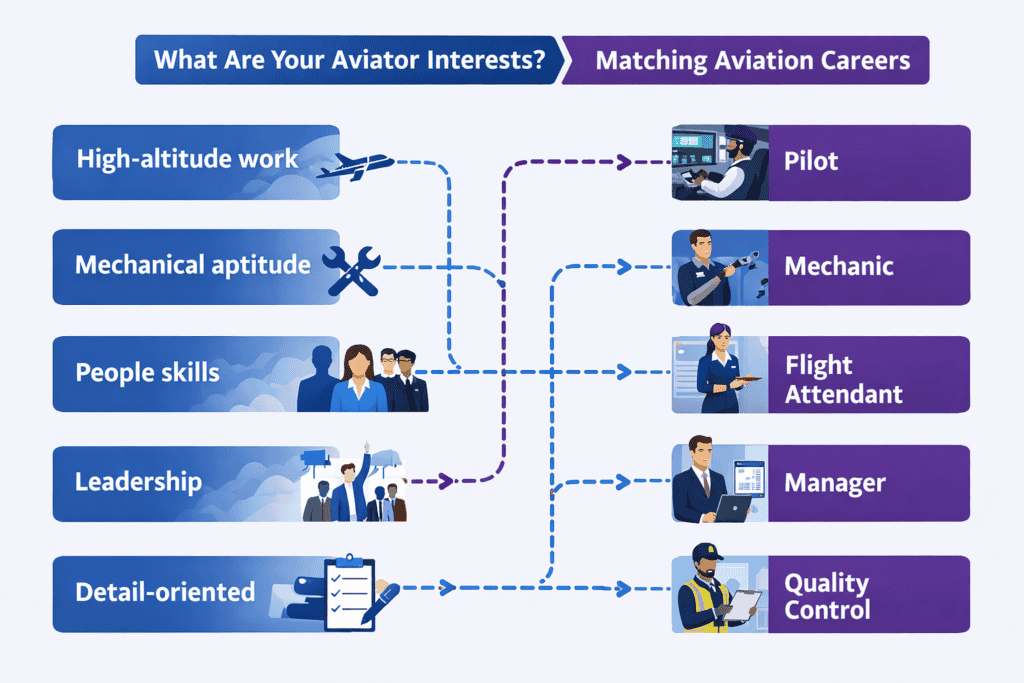
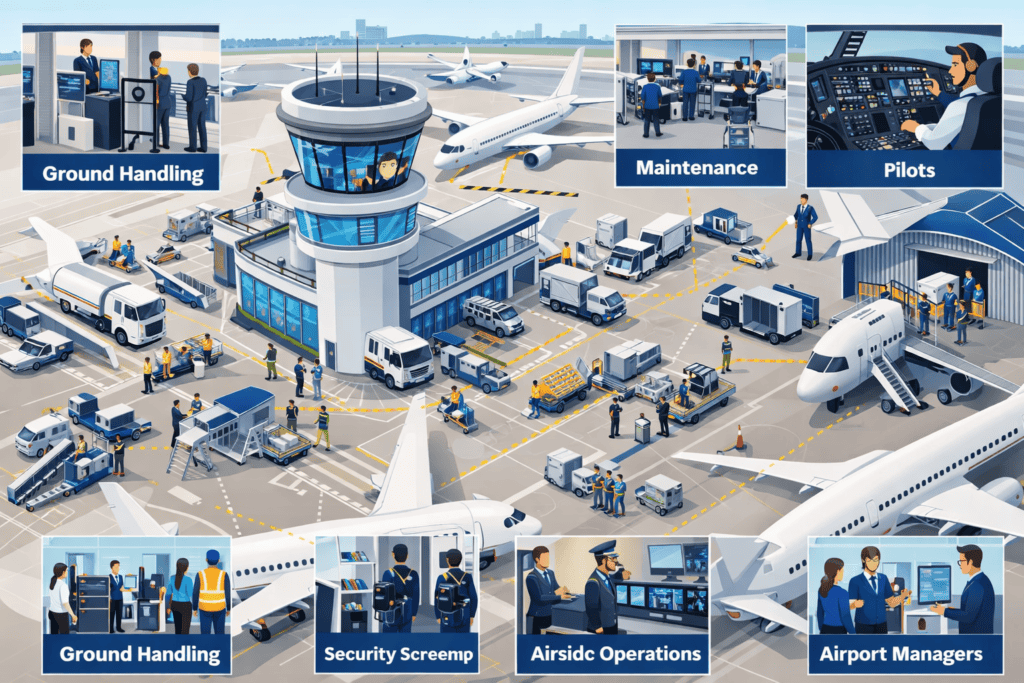
Pilots and flight crews including commercial pilots, flight engineers, and flight attendants represent the most visible aviation careers. Air traffic control manages aircraft movements safely through airspace. Airport operations encompasses everything from ground handling to airport management. Aircraft maintenance keeps aircraft safe and operational.
Airline operations and management coordinates flight operations, crew scheduling, and logistics. Aviation education trains next-generation aviation professionals. Airport and airline security protects passengers and aircraft. Cargo and logistics moves freight and packages globally.
Pilot Careers
Commercial pilots typically earn $120,000-$250,000+ annually depending on airline and experience. Becoming a pilot requires 1,500+ flight hours, commercial pilot certification, and airline hiring. Training costs $150,000-$250,000, creating significant upfront investment. However, earning potential justifies the investment, with pilots reaching six-figure salaries within 10-15 years.
For detailed pilot career information, see our guides on highest paying aviation jobs and airline pilot opportunities.
Air Traffic Control Careers
Air traffic controllers earn $120,000-$150,000+ annually. Becoming a controller requires FAA training (3-4 years), initial facility assignment, and progressive advancement through increasingly complex facilities. Controllers face significant responsibility managing aircraft safety, work irregular shifts, and experience high stress during busy periods.
For detailed ATC information, see our complete guide on becoming an air traffic controller and what air traffic control is.
Airport Operations Careers
Airport operations encompasses ground handling ($20,000-$40,000 entry-level to $100,000+ management), ramp operations ($25,000-$50,000), duty management ($85,000-$120,000), and airport management ($95,000-$200,000). These careers typically require progressive advancement starting in entry-level positions.
For detailed airport career information, see our guides on ground handling jobs, airport duty manager responsibilities, and airport operations fundamentals.
Aircraft Maintenance Careers
Aircraft maintenance technicians earn $45,000-$75,000 annually, with supervisors earning $70,000-$120,000. Maintenance careers require A&P (Airframe and Powerplant) certification, typically requiring 18-24 months of training. Maintenance work is technically complex, safety-critical, and offers stable employment.
Airline Operations Management
Airline operations managers earn $90,000-$150,000+ annually. These roles require progressive advancement through operational positions, often starting in ground operations or flight operations. Advancement typically requires bachelor’s degrees in airline management or related fields.
Specialized Aviation Careers
Pilot dispatchers plan routes, coordinate weather, manage flight operations ($50,000-$80,000). Flight planning specialists calculate fuel requirements and weight/balance ($40,000-$70,000). Aviation safety specialists investigate incidents, manage safety programs ($60,000-$100,000). Avionics technicians repair aircraft electronics ($50,000-$90,000).
Education Requirements by Career
Entry-level positions (baggage handling, cleaning, basic ramp work) require high school diploma only. Supervisory positions typically require high school diploma plus 3-5 years experience. Specialized technical roles (maintenance, fueling) require certification but not college education. Management positions increasingly prefer bachelor’s degrees. Pilot careers require extensive flight training but not college education (though many pilots have degrees).
Salary Progression by Career Path
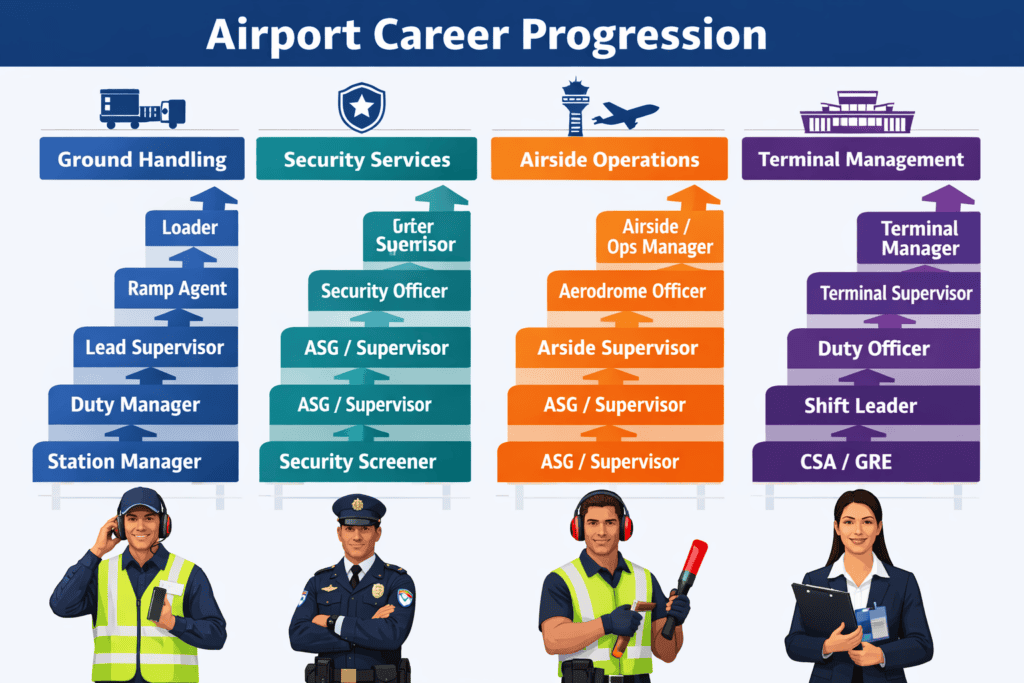
Ground handling pathway: Entry-level $20,000 → Supervisor $45,000 → Operations Manager $80,000 → Airport Manager $150,000+. Typical timeline: 15-20 years.
Pilot pathway: Training costs $150,000-$250,000 → Regional first officer $80,000 → Regional captain $150,000 → Major airline first officer $180,000 → Major airline captain $250,000+. Typical timeline: 15-20 years to captain at major airline.
ATC pathway: Training cost ~$25,000 → Controller entry facility $70,000 → Controller large facility $130,000 → Facility management $150,000+. Typical timeline: 12-18 years to management.
Maintenance pathway: A&P training cost $30,000-$50,000 → Technician $50,000 → Lead technician $70,000 → Maintenance supervisor $90,000 → Maintenance manager $120,000+. Typical timeline: 12-15 years to management.
Working Conditions and Lifestyle
Aviation careers involve irregular schedules—pilots work nights/weekends, controllers work shift work, ground handlers work all hours. Some aviation workers travel frequently (pilots stay overnight in multiple cities weekly), while others work local fixed locations. Stress levels vary—pilots face responsibility for aircraft and passengers, controllers face intense pressure managing safety, while some support roles have lower stress.
Benefits in aviation are typically strong—health insurance, retirement plans, paid time off. Airlines provide benefits including flight benefits (employees fly standby at discounted rates). Unions represent pilots, air traffic controllers, and many airline workers, securing benefits and pay scales.
Advancement Opportunities
Aviation careers typically have clear advancement pathways. Ground handlers advance to supervisors and management. Pilots advance from regional airlines to major carriers and captain positions. Controllers advance from small facilities to major facilities and management. This structured progression provides career stability and earning growth.
Some pilots transition to airline management. Some controllers move to FAA headquarters. Some ground handlers reach airport director positions. Lateral moves between aviation sectors are possible—a pilot might transition to airline operations, a controller might move to airport operations.
Conclusion
Aviation offers career opportunities at all education and experience levels, from entry-level ground handling to six-figure pilot and management careers. Career progression is typically clear, earnings potential is strong, and the industry provides rewarding work for those passionate about aviation. Whether seeking entry-level employment, specialized training, or advanced management positions, aviation has opportunities matching diverse interests and capabilities.
For specific career information, see our detailed guides on becoming an airport manager, airport security supervisor and airport management careers.
Sources & References
- Bureau of Labor Statistics – Aviation Careers and Wages
- Federal Aviation Administration – Career Resources
- Airlines Association – Career Information
Pingback: How Airports Make Money | Airport Revenue Streams Explained
Pingback: Highest Paying Aviation Jobs 2026 (Up to $400K)