About the Author: Knight is an aviation professional with extensive experience in airport operations and aviation career development. He specializes in helping aspiring aviation professionals understand career paths, salary expectations, and advancement opportunities. His expertise comes from working directly with aviation employers and industry professionals. Kinght’s mission is to make complex aviation career information accessible to everyone interested in the aviation industry.
Introduction
Aviation professionals and the public sometimes use “security” and “safety” interchangeably, but these terms describe different functions with different goals and methods. Security protects aviation from external threats like terrorism and theft. Safety addresses internal risks like mechanical failure, human error, and accidents. Understanding the distinction between these two critical functions explains how aviation addresses different risks and why both security and safety procedures exist.
This comprehensive guide explains aviation security vs. aviation safety, how they differ, how they work together, and why aviation requires both comprehensive security and safety systems. Whether you work in aviation or are simply curious about how aviation is protected, this guide clarifies the important distinction.
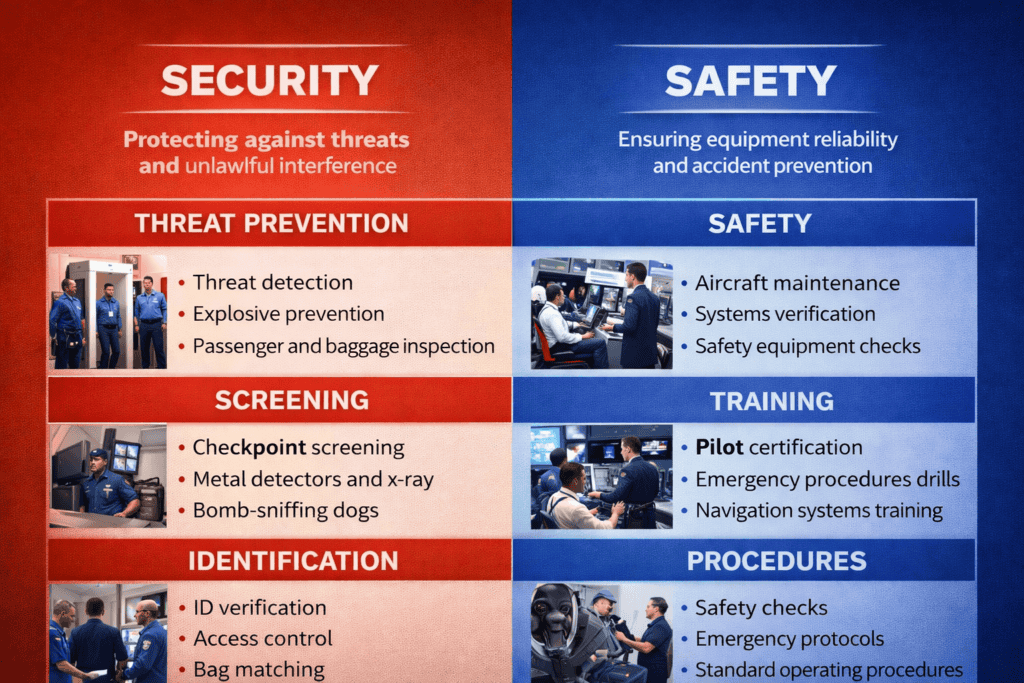
What is Aviation Security?
Aviation security is the system of procedures, equipment, and personnel designed to protect aviation from intentional threats—terrorism, sabotage, weapons smuggling, and other intentional harm. Security addresses human-driven threats where someone deliberately attempts to harm aviation.
Security measures include passenger and baggage screening, airport perimeter security, access controls preventing unauthorized access to aircraft and restricted areas, intelligence gathering identifying potential threats, and air marshals responding to in-flight threats. For comprehensive information on aviation security, see our detailed guide on what is aviation security.
What is Aviation Safety?
Aviation safety is the system of design, procedures, training, and maintenance ensuring aircraft operate without accidents. Safety addresses mechanical failures, human error, weather hazards, and other hazards that could cause accidents. Safety includes aircraft design standards ensuring structural integrity, maintenance procedures preventing mechanical failures, pilot training establishing proper procedures, cockpit procedures managing hazards, and accident investigation improving systems.
Safety is fundamentally different from security—safety addresses unintentional failures and hazards while security addresses intentional threats.
Key Differences
Threat Type: Security addresses intentional threats (terrorism, sabotage). Safety addresses unintentional failures (mechanical problems, human error, weather).
Problem Source: Security threats come from external adversaries. Safety problems come from system weaknesses (design, maintenance, training, procedures).
Prevention Method: Security prevents through barriers (perimeter fencing, locks, screening) and detection (surveillance, screening equipment). Safety prevents through design (aircraft that withstand failures), maintenance (replacing worn parts), training (proper procedures), and procedures (standard operating procedures).
When Implemented: Security is primarily before flight—screening passengers and baggage, controlling access. Safety is throughout aircraft design, maintenance, operation, and emergency response.
Authority: Security is managed by law enforcement, TSA, and federal agencies. Safety is managed by FAA, manufacturers, airlines, and mechanics.
How They Work Together
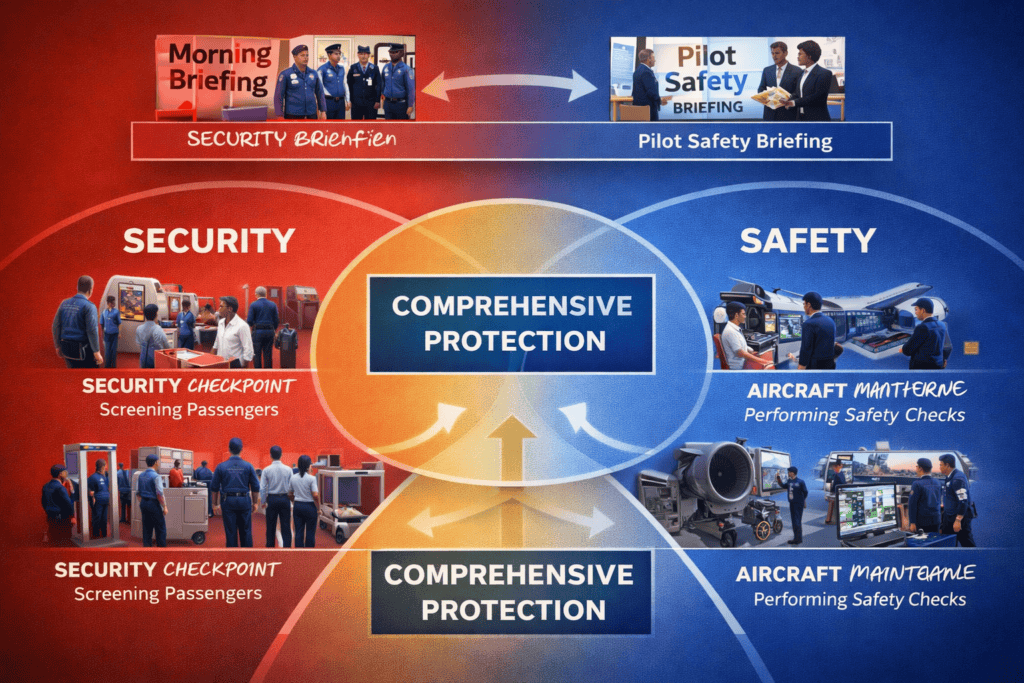
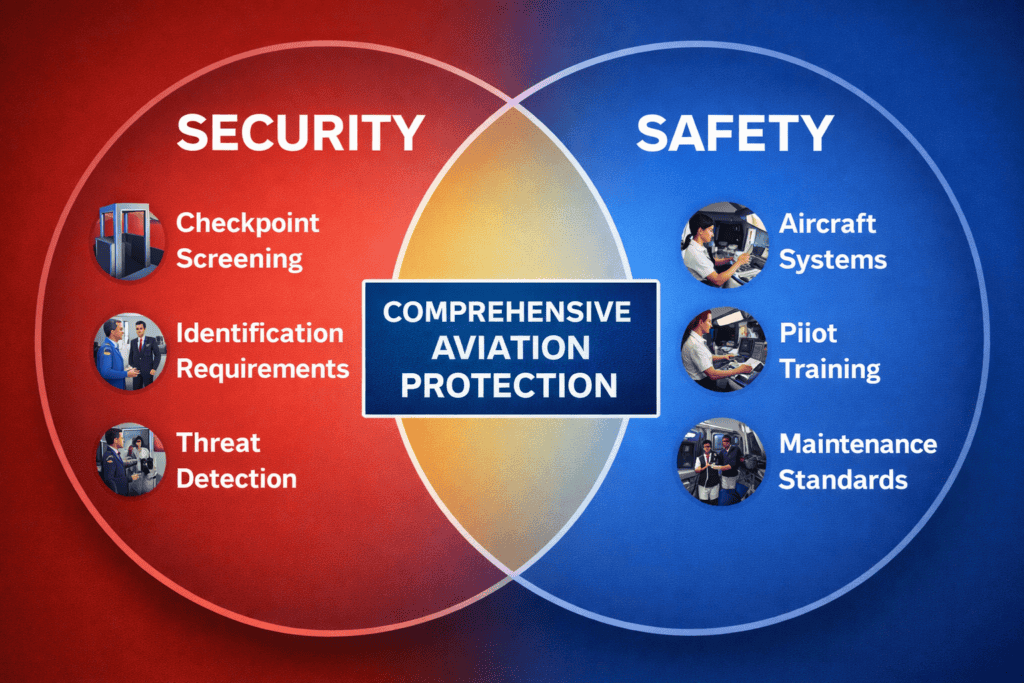
Despite different objectives, security and safety systems work together protecting aviation. Strong cockpit doors (security) prevent hijacking but also support safety by protecting flight deck from cabin hazards. Air traffic control (safety) manages aircraft separation but includes security surveillance. Maintenance programs (safety) ensure aircraft are reliable, creating aircraft less vulnerable to sabotage.
Some measures serve both functions. Background checks on airport employees (security) also ensure reliable personnel for safety-critical roles (security prevents malicious employees, safety ensures all personnel are properly trained).
Examples Illustrating the Difference
Example 1: Bomb Threat
- Security response: Authorities evacuate areas, search for devices using detection equipment, interview people to gather intelligence, investigate who made the threat
- Safety response: If explosion occurred, response would include rescue, medical care, investigation of why aircraft design/maintenance didn’t prevent damage
Example 2: Engine Failure
- Safety issue: Engine failed due to part defect. Maintenance records examined, FAA investigates, directive issued to replace similar parts on other aircraft
- Security non-issue: No terrorist involvement, just mechanical failure
Example 3: Hijacking Attempt
- Security issue: Individual attempts to force into cockpit. Air marshals intervene, plane diverts, person arrested
- Safety not directly involved: Although pilot’s decision-making and cockpit procedures (safety functions) might be reviewed
Why Both Are Essential
Aviation cannot rely on security alone—mechanical failures, weather hazards, and human error cause accidents regardless of security measures. A secure aircraft that crashes due to mechanical failure has failed its fundamental purpose of safe transportation.
Conversely, aviation cannot rely on safety alone—in today’s world, intentional threats (terrorism, sabotage) present real risks that safety systems alone cannot address.
Historical Development
Modern aviation safety developed in the 1960s-1980s as commercial aviation expanded. The FAA established maintenance standards, pilot training requirements, and airworthiness standards. NTSB accident investigations identified systemic issues driving regulatory improvements. This resulted in one of the world’s safest transportation modes.
Modern aviation security developed dramatically after 9/11. Before 2001, security was minimal—passengers could bring most items through screening, cockpit access was unrestricted. After terrorists used aircraft as weapons, security was dramatically enhanced. Cockpit doors were reinforced, screening became more thorough, air marshals were assigned to flights.
Industry Perspectives
Safety professionals focus on accident prevention—designing reliable aircraft, training competent crews, maintaining equipment properly. Safety culture emphasizes reporting problems, learning from accidents, and continuous improvement.
Security professionals focus on threat prevention—preventing malicious individuals from harming aviation. Security culture emphasizes vigilance, detection, and rapid response to threats.
Both communities recognize the other’s importance and work together, though their primary focus differs.
Public Perception and Reality
The public often conflates security and safety. After 9/11, security enhancements made people feel safer. However, statistically, mechanical safety improvements have greater impact on accident reduction than security measures. Modern aircraft design, maintenance standards, and pilot training have made aviation exceptionally safe—far safer than driving.
Security prevents specific threat types but doesn’t prevent mechanical accidents. Safety prevents mechanical accidents but doesn’t prevent intentional attacks. Both systems are essential.
Balancing Security and Safety with Efficiency
Both security and safety measures add time and cost to aviation. Security screening adds to airport time requirements. Safety maintenance procedures add to aircraft downtime. Efficient operations must balance these requirements.
Carriers invest in both security and safety, recognizing both are essential. The cost of security (screening equipment, personnel, air marshals) is accepted as necessary despite inconvenience. The cost of safety (comprehensive maintenance, pilot training, aircraft design) is accepted as necessary despite cost impact on operations.
Conclusion
Aviation security and aviation safety are distinct but complementary systems. Security protects against intentional threats while safety protects against unintentional hazards. Both are essential—security without safety would result in accidents from mechanical failure, safety without security would leave aviation vulnerable to terrorism.
Modern aviation combines world-class safety systems (resulting in exceptional accident prevention) and strong security systems (preventing intentional threats). This combination has made aviation the safest transportation mode and terrorism-resistant despite its attractiveness as a target.
For more information on aviation security, see our guide on what is aviation regulations. For information on aviation safety, see our articles on airport emergency response and air traffic control safety.
Sources & References
- Federal Aviation Administration – Safety and Security Standards
- Transportation Security Administration – Security Procedures
- National Transportation Safety Board – Safety Recommendations
- Department of Homeland Security – Aviation Security Policy
Pingback: What Is Aviation Security? Beginner’s Guide
Pingback: Aircraft Turnaround Process Explained: Step-by-Step Guide to Airport Ground Operations
Pingback: Airport Emergency Response Plan Explained (2026)
Pingback: "Pre-Flight Inspection: Complete Pilot Walkthrough Guide 2026"
Pingback: "Minimum Equipment Lists (MEL): Operating Aircraft With Broken Parts 2026"
Pingback: "What Is Turbulence? Why Planes Shake & Safety Explained 2026"