About the Author: Knight is an aviation professional with extensive experience in airport operations and aviation career development. He specializes in helping aspiring aviation professionals understand career paths, salary expectations, and advancement opportunities. His expertise comes from working directly with aviation employers and industry professionals. Kinght’s mission is to make complex aviation career information accessible to everyone interested in the aviation industry.
Introduction
Thousands of aircraft fly simultaneously across United States airspace, separated by only a few thousand feet vertically and several miles horizontally. Without constant coordination and control, collisions would be inevitable. Air traffic control is the sophisticated system that manages this airspace, continuously monitoring aircraft positions, issuing instructions to pilots, and maintaining safe separation between all aircraft. This remarkable system ensures that aviation is one of the safest transportation modes despite the complexity and volume of traffic.
Air traffic control is performed by highly trained professionals working in control towers at airports and radar facilities controlling en-route (between airports) traffic. These professionals monitor radar screens, listen to pilot radio communications, make split-second decisions, and ensure separation and safety across vast areas of airspace. Understanding how ATC works explains why certain procedures exist, explains communication between pilots and controllers, and appreciates the skill required in this critical profession.
What is Air Traffic Control?
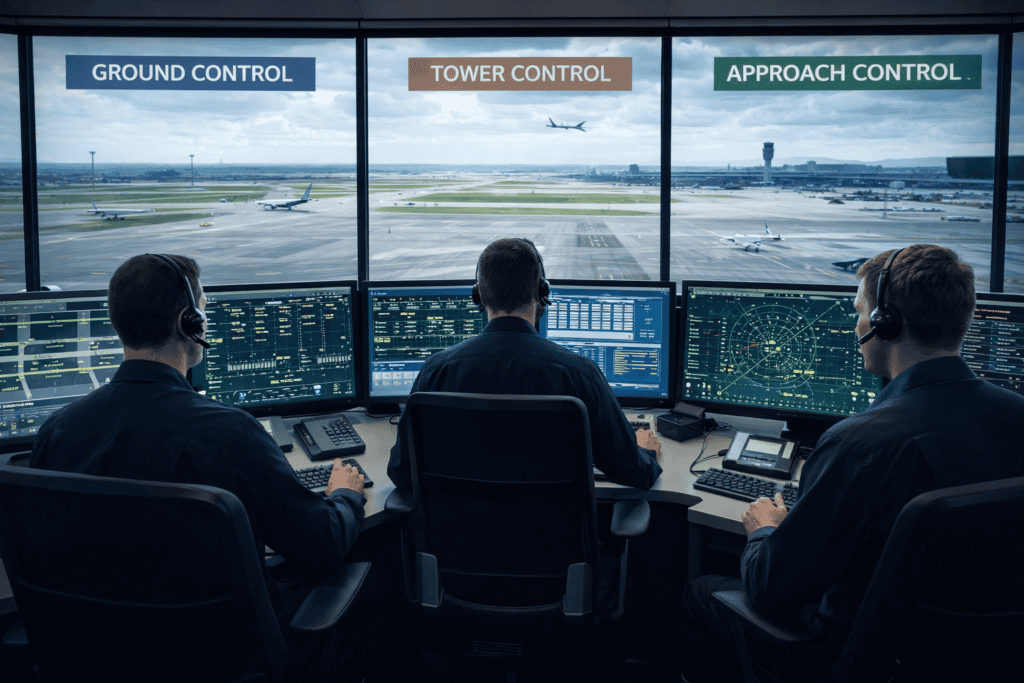
Air traffic control is the system of managing aircraft movements to maintain safe separation, prevent collisions, and facilitate efficient movement through airspace. This includes controlling aircraft on the ground (taxiing), during takeoff, en-route between airports, during approach to landing, and during landing. Each phase has specific control requirements and specific procedures.
Tower Control vs. Radar Control
Control towers manage aircraft within approximately 5 miles of airports. Controllers in towers see aircraft visually and on radar, maintaining communication with pilots, issuing clearances for takeoff, directing aircraft to proper runways, and managing ground movement. Tower controllers work in facilities located at airport control towers, high enough to see the airport and surrounding airspace.
Radar controllers manage en-route traffic—aircraft between airports. Controllers using radar facilities can see aircraft positions, altitudes, and speeds on radar screens. They issue altitude assignments, routing changes, and separation instructions based on radar information. En-route controllers work in radar facilities located away from airports, typically in major metropolitan areas. For more information on ATC careers, see our complete guide on becoming an air traffic controller.
How Radar Works
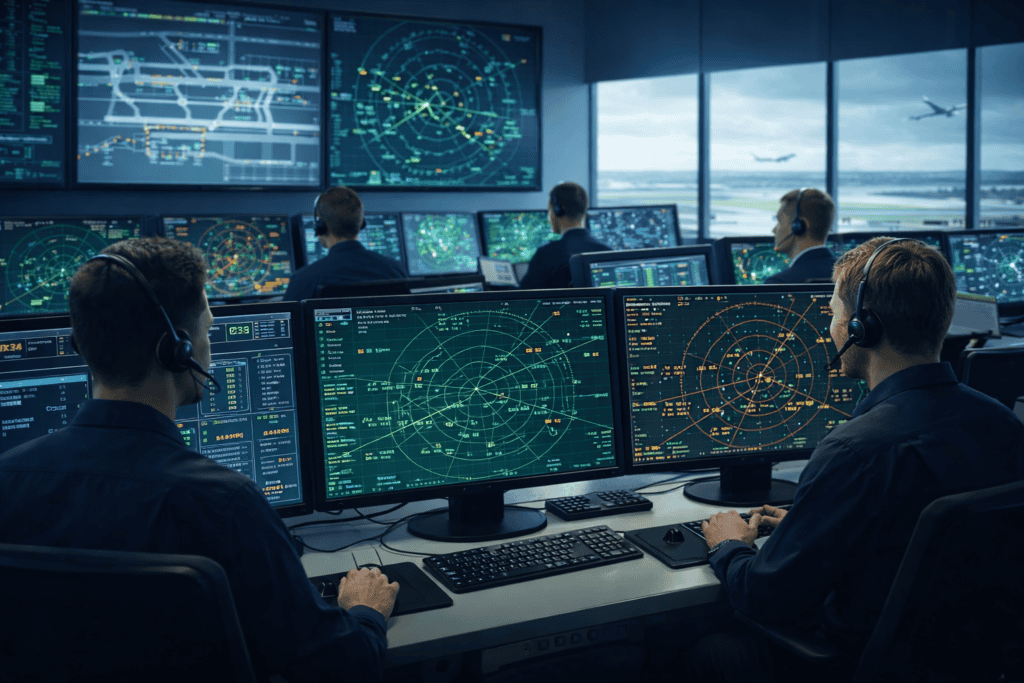
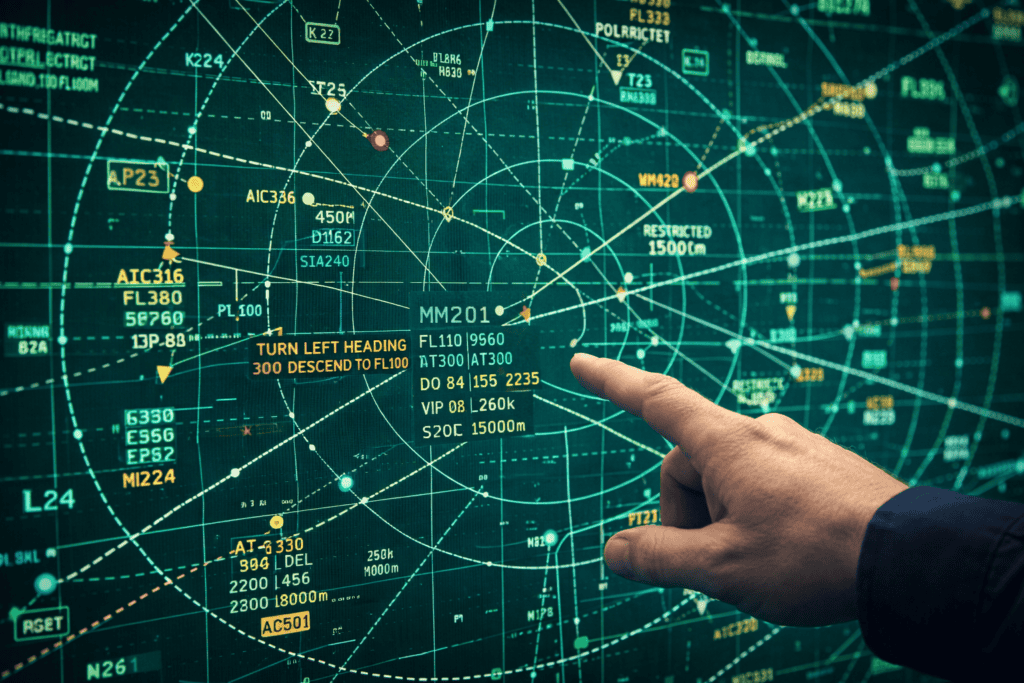
Modern radar systems continuously transmit radio waves that reflect off aircraft. Return signals show aircraft position, altitude, and speed. Controllers interpret this radar information, maintaining mental awareness of hundreds of aircraft simultaneously. Computer systems assist by tracking aircraft and automatically generating warnings if separation conflicts develop.
Radar has limitations—it doesn’t show the aircraft interior, can’t identify specific aircraft among multiple targets, sometimes creates false returns, and has dead zones in mountainous terrain. Controllers use multiple sources of information—radar, pilot radio reports, flight plan data—to build complete awareness.
Communication and Pilot-Controller Interaction
Pilots and controllers communicate on specific radio frequencies. Controllers issue clearances—takeoff clearances, altitude assignments, heading instructions, approach clearances. Pilots acknowledge clearances, report positions, and request changes. This constant communication provides real-time coordination between pilots and controllers.
Standardized phraseology ensures clear understanding despite language barriers (English is the international aviation language). Controllers say “climb to flight level 350” meaning “increase altitude to 35,000 feet.” Pilots respond “climbing to flight level 350” confirming the instruction. This standardized communication prevents misunderstandings that could compromise safety.
Separation Standards
Controllers maintain minimum separation between aircraft—typically 1,000 feet vertically or 3 miles horizontally, depending on phase of flight. These standards ensure that even if one aircraft’s altitude instrument fails, the aircraft won’t collide with another. Near airports during busy periods, separation standards are smaller, requiring more precise control.
Wake turbulence—turbulent air created by aircraft as they move through the sky—creates additional separation requirements. Large aircraft create stronger wake turbulence than small aircraft, requiring larger separation. Controllers ensure aircraft following large aircraft maintain adequate separation to avoid wake turbulence effects.
Challenges ATC Faces
Controllers work under intense pressure—managing dozens or hundreds of aircraft simultaneously, making safety-critical decisions, and remaining focused throughout shifts. Weather complications—thunderstorms require routing changes, low visibility limits operations, wind affects aircraft movements. Equipment failures—radar systems fail, radio systems malfunction, computers crash—requiring controllers to operate with reduced information.
Peak hours create capacity limits—some airports and airspace sectors can handle only a certain number of aircraft per hour. When demand exceeds capacity, aircraft are delayed. Rush hour traffic on highways has parallels in airspace—same traffic, same routes, same time creates congestion.
ATC Separation Standards and Nextgen
The traditional radar-based separation system works well but has limitations. The FAA is transitioning to NextGen (Next Generation Air Transportation System), which uses GPS-based positioning (ADS-B) for more accurate aircraft tracking. With better precision, separation standards can be reduced, allowing more aircraft in the same airspace.
NextGen also enables more efficient routing, reducing flight times and fuel consumption. Controllers can see aircraft positions with greater precision, allowing more flexible routing than traditional airways. Automated tools assist controllers, reducing workload and preventing errors.
ATC and Airport Safety
ATC directly prevents collisions and near-misses. Controllers see conflicts developing before pilots recognize them, issuing corrective instructions. Traffic alert systems in aircraft provide additional backup, warning pilots of traffic even if controllers don’t catch conflicts. Multiple layers of safety—ATC, automated systems, pilot awareness—create an extraordinarily safe system.
Conclusion
Air traffic control is one of aviation’s most critical functions, ensuring that thousands of simultaneous flights maintain safe separation and reach destinations efficiently. Controllers are highly trained professionals managing complex systems under pressure, applying standardized procedures, and continuously learning. The system they operate—combining radar, radio communication, and professional expertise—maintains one of the world’s safest transportation systems.
For more information on air traffic control, see our guide on becoming an ATC and our article on how airports manage operations.
Sources & References
- Federal Aviation Administration – ATC Operations and Procedures
- FAA Order on Air Traffic Control – Standard Operating Procedures
- Next Generation Air Transportation System (NextGen) Documentation
Pingback: Air Traffic Controller Career Guide: Salary & Requirements
Pingback: Aviation Security and Airport Operations: How They Work Together
Pingback: "Runway Configuration: Why Airports Have Multiple Runways 2026"
Pingback: Highest Paying Aviation Jobs 2026 (Up to $400K)