Major airports have multiple runways. New York’s JFK has 4 runways. Los Angeles has 4. Chicago has 3.
Why do airports need multiple runways? Why not just have one big runway?
Runway configuration is complex but critical to airport operations.
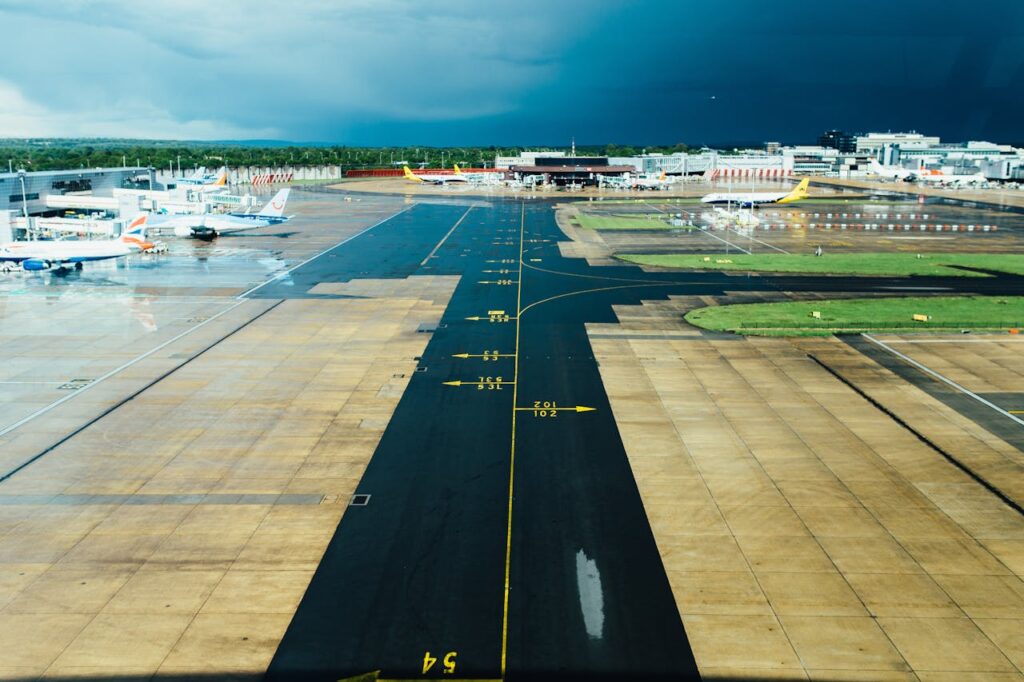
Why Multiple Runways?
Several critical factors drive the need for multiple runways.
Capacity:
- One runway can handle ~50 operations per hour (takeoffs/landings)
- Major airport needs 300+ operations per hour
- Multiple runways needed to meet demand
Efficiency:
- Can separate arrivals and departures
- Some runways for takeoffs
- Some runways for landings
- Reduces conflicts and delays
Redundancy:
- If one runway closes (maintenance), others remain open
- Airport can continue operating
- Safety margin if problems occur
- Contingency for emergencies
Wind Direction:
- Aircraft take off/land into wind (for safety)
- Wind direction changes
- Different runways oriented for different wind directions
- Allows operations in any wind condition
Runway Orientation
Runways are designated by compass direction for clear identification.
Runway Direction:
- Runways designated by magnetic compass direction
- Rounded to nearest 10°
- North = 0°, East = 90°, South = 180°, West = 270°
Examples:
- Runway 09 = 90° compass = East/West runway
- Runway 27 = 270° compass = East/West runway (opposite direction)
- Runway 03 = 30° compass = Northeast/Southwest runway
- Runway 21 = 210° compass = Northeast/Southwest runway
Why Opposite Numbers:
- Runway 09 and 27 are same physical runway
- 09 = landing from east
- 27 = landing from west
- Both directions on same runway
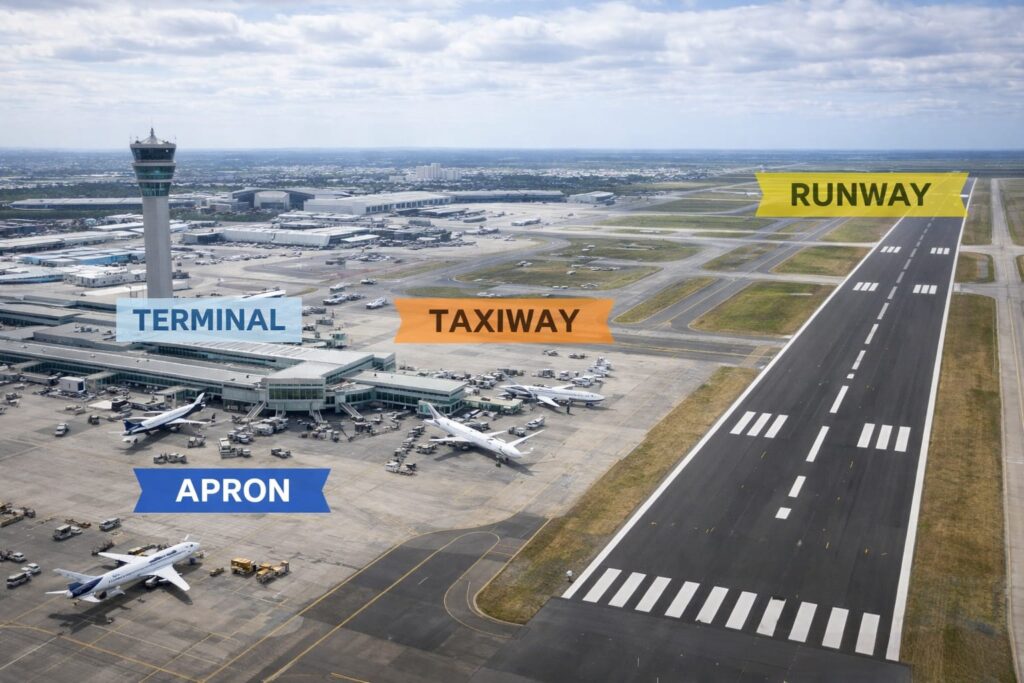
Parallel Runway Operations
Many airports have parallel runways for increased capacity.
Configuration:
- Two or more runways side-by-side
- Running same direction (usually)
- Separated by specific distance
- Operated simultaneously
Advantage:
- Can handle twice the capacity
- Both arrivals and departures
- Simultaneous operations
- Significantly increases airport capacity
Example:
LAX has Runways 24L (left) and 24R (right).
- Both runways oriented 240°
- Parallel to each other
- Can operate simultaneously
- Nearly double capacity
Spacing Requirement:
- Parallel runways must be 4,300+ feet apart
- Closer spacing requires special procedures
- Safety and operational considerations
- Some airports have runways closer (older airports)
Crosswind Limits
Aircraft have limitations on crosswind operations.
Aircraft Limitations:
Aircraft can’t take off/land with strong crosswind (wind perpendicular to runway). Different aircraft have different crosswind limits.
Examples:
- Boeing 737: Maximum crosswind ~25 knots
- Airbus A320: Maximum crosswind ~25 knots
- Regional aircraft: Lower limits (~20 knots)
Why Limit:
- Crosswind pushes aircraft off runway
- Pilot corrects but has limits to correction
- Too much crosswind = loss of control
- Different aircraft have different capabilities
Wind Direction Impact:
- If wind is 25 knots from east
- Runway 09/27 (east-west) = bad crosswind
- Runway 03/21 (northeast-southwest) = better aligned with wind
Solution: Multiple Runways
- Different orientations
- Can find runway aligned with wind
- Operations continue regardless of wind direction
Runway Selection
ATC considers multiple factors when assigning runways.
Considerations:
- Wind Direction – Choose runway most aligned with wind. Minimize crosswind. Maximize headwind.
- Traffic Patterns – Avoid crossing paths. Separate arrivals and departures. Maximize throughput.
- Noise Abatement – Use runways minimizing residential impact. Schedule to alternate runways. Community noise considered.
- Weather – Avoid runways with weather problems. Visibility considerations. RVR (runway visual range) affects selection.
The Logic:
ATC chooses runway based on conditions, efficiency, and safety.
Runway Interdependencies
Some parallel runways cannot be used simultaneously due to technical limitations.
Dependent Runways:
- Some parallel runways cannot be used simultaneously
- Operational procedures vary
- Depends on runway spacing
- Affects total capacity
Example:
- Runways very close together
- Can use only one at a time during poor visibility
- During good visibility, can use both
- Weather-dependent capacity
Capacity Impact:
- Good weather: High capacity (multiple runways)
- Poor weather: Lower capacity (fewer runway combinations)
- This explains weather-delay variability
Runway Design Specifications
Runways must meet specific technical requirements.
Length Requirements:
- Heavy aircraft need longer runways
- Takeoff requires longer runway than landing
- Altitude affects runway length needed
- Weight, temperature, weather affect requirements
Standard Lengths:
- Small regional airport: 5,000 feet
- Mid-size airport: 8,000 feet
- Major airport: 10,000-12,000+ feet
- International airport: 12,000+ feet
Why Longer:
- Air resistance at altitude
- High weight aircraft
- Safety margins
- Summer (hot) requires more distance
Width Requirements:
- Wide-body aircraft (Boeing 777): Need wider runways
- Narrow-body aircraft: Smaller runways acceptable
- Standard: 150 feet wide
- Some: 200 feet wide
Surface Requirements:
- Asphalt or concrete (not dirt)
- Grooved surface for water drainage
- Markings and lights
- Constant maintenance
Runway Numbering System
The numbering system is based on compass heading.
Why Numbers?
- Magnetic heading
- Easy to identify
- Universal system
- Compass-based
Examples:
- Runway 12 = 120° magnetic
- Runway 30 = 300° magnetic
- Runway 35L = 350° magnetic, left runway
Confusion Point:
- Runway 09 ≠ 9 o’clock position
- Runway 09 = 90° compass direction = actual EAST
- Actual compass directions, not clock positions
Why Not Just One Runway?
A single runway would be insufficient for major airports.
Theoretical Option:
Could airport have just one very long runway?
Problems:
1. Capacity insufficient:
- 50 operations/hour max
- Major airport needs 300+
- Would need 6+ hour waits
2. Inefficiency:
- Can’t separate arrivals/departures
- Can’t alternate directions
- Wind direction limitations
- Operational constraints
3. Closure Issues:
- One runway closed = entire airport closed
- No redundancy
- No contingency
- Extremely problematic
4. Economic Impact:
- Delays = lost revenue
- Cancellations = lost revenue
- Customer satisfaction issues
- Competitive disadvantage
The Solution:
Multiple runways allow:
- Higher capacity
- Better efficiency
- Redundancy
- Weather flexibility
- Operational optimization
Modern Runway Improvements
Airports continuously improve runway systems.
Design:
- Grooved surfaces reduce hydroplaning
- Better drainage systems
- Improved markings
- Better lighting
Technology:
- Precision approach radar
- Automated landing systems
- Real-time surface condition monitoring
- Advanced weather sensing
Automation:
- Runway occupancy detection
- Automated lighting
- Surface friction measurement
- Runway incursion prevention
Conclusion
Runway configuration is carefully designed to maximize:
- Safety
- Capacity
- Efficiency
- Redundancy
- Weather flexibility
Multiple runways with different orientations allow airports to handle high traffic volumes safely and efficiently.
Understanding runway configuration shows how airports are engineered for optimal operations.
The next time you land, notice the runway designation and understand it represents magnetic heading orientation.
Major airports have multiple runways for good reason—a single runway simply cannot handle the volume of flights modern airports need to accommodate. Multiple runways allow airports to separate arrivals and departures, operate in different wind conditions, and provide redundancy if one runway needs maintenance. Runway configuration is carefully designed to maximize capacity while maintaining safety and minimizing noise impact on surrounding communities. Understanding why airports need multiple runways helps explain both their design and the regulations governing their use.