About the Author: Knight is an aviation professional with extensive experience in airport operations and aviation career development. He specializes in helping aspiring aviation professionals understand career paths, salary expectations, and advancement opportunities. His expertise comes from working directly with aviation employers and industry professionals. Kinght’s mission is to make complex aviation career information accessible to everyone interested in the aviation industry.
Introduction
Every time a commercial aircraft lands at an airport, it disappears into a frenzy of coordinated activity. Ground crews swarm around the aircraft, simultaneously unloading passengers, baggage, and cargo while preparing the aircraft for departure. Fueling trucks connect, catering vehicles arrive, cleaners board the aircraft, maintenance inspectors crawl underneath, and dozens of other tasks happen simultaneously on a strict timeline. This controlled chaos is the aircraft turnaround—one of aviation’s most complex and time-critical operational procedures.
Understanding the aircraft turnaround process provides insight into how airlines minimize aircraft downtime, explains why flights are scheduled the way they are, and demonstrates the coordination required in modern aviation. This comprehensive guide walks through every step of the turnaround process, explains the teams involved, examines how time is minimized, and discusses how problems during turnarounds affect overall airport operations.
What is Aircraft Turnaround?
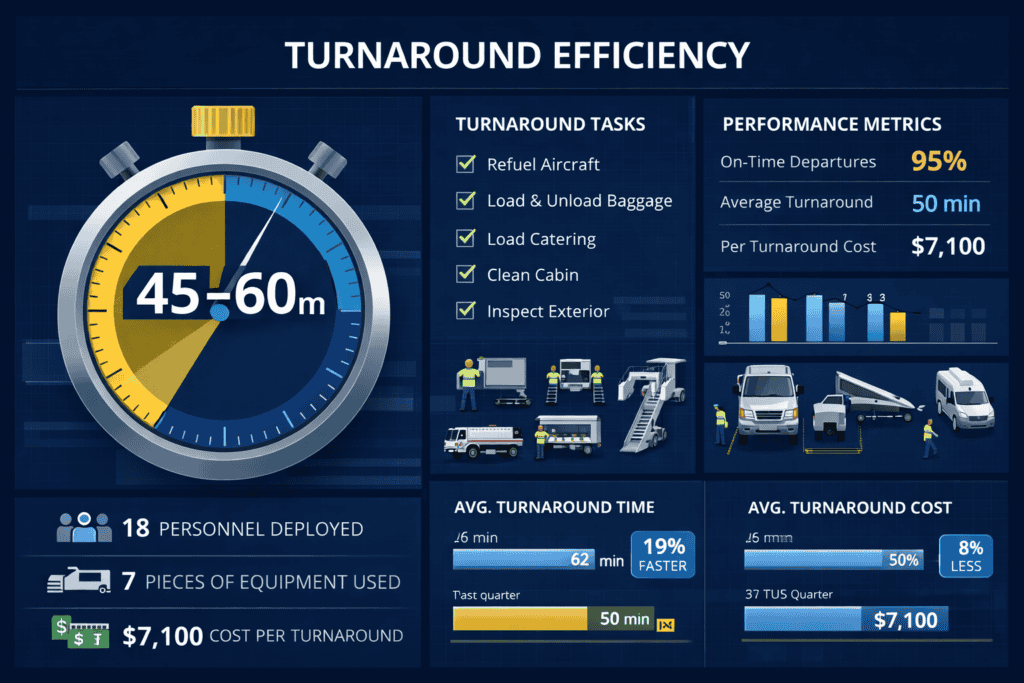
Aircraft turnaround is the period between when an aircraft lands and when it departs again with passengers and cargo. This typically ranges from 45 minutes for quick turnarounds on short regional flights to several hours for long-haul international flights. The goal is to accomplish everything necessary to safely and legally prepare the aircraft for its next flight while moving through this period as quickly as possible. Every minute a $150+ million aircraft sits idle costs the airline money in depreciation and lost revenue.
Pre-Arrival Planning
Turnaround planning begins before the aircraft even lands. Airlines calculate required turnaround times based on aircraft type, route length, expected passenger count, cargo, catering requirements, and maintenance needs. International flights require longer turnarounds due to more complex catering, cargo handling, and potential maintenance requirements. Domestic short-haul flights can be turned quickly if they don’t require deep cleaning or extensive maintenance. Airlines balance quick turnarounds against thorough procedures to ensure safety and cleanliness.
The gate agent and ground handling manager review the flight plan, identifying special requirements. Does this flight require additional cleaning due to passenger illness? Do scheduled maintenance inspections need to occur? Are there mechanical issues from the previous flight? Is cargo unusually heavy, requiring extra fueling? Careful planning ensures all necessary tasks are identified before the aircraft arrives.
Passenger Deplaning (10-20 minutes)
When the aircraft parks at the gate, passengers can immediately begin exiting. The aircraft door opens and bridge (jet bridge) connects to the aircraft. Passengers walk through the bridge to the terminal. For a full aircraft with 150+ passengers, this typically requires 15-20 minutes. Passengers with mobility issues requiring assistance take longer. For remote stands without jet bridges, passengers walk to buses or use stairs. Aircraft with multiple doors can facilitate faster deplaning.
Ground crews begin work immediately—boarding bridge operators ensure safe connections, gate agents assist passengers, and ground crews prepare baggage systems. This seemingly simple step requires careful coordination between airline, airport ground handlers, and passengers.
Baggage Unloading (15-30 minutes)
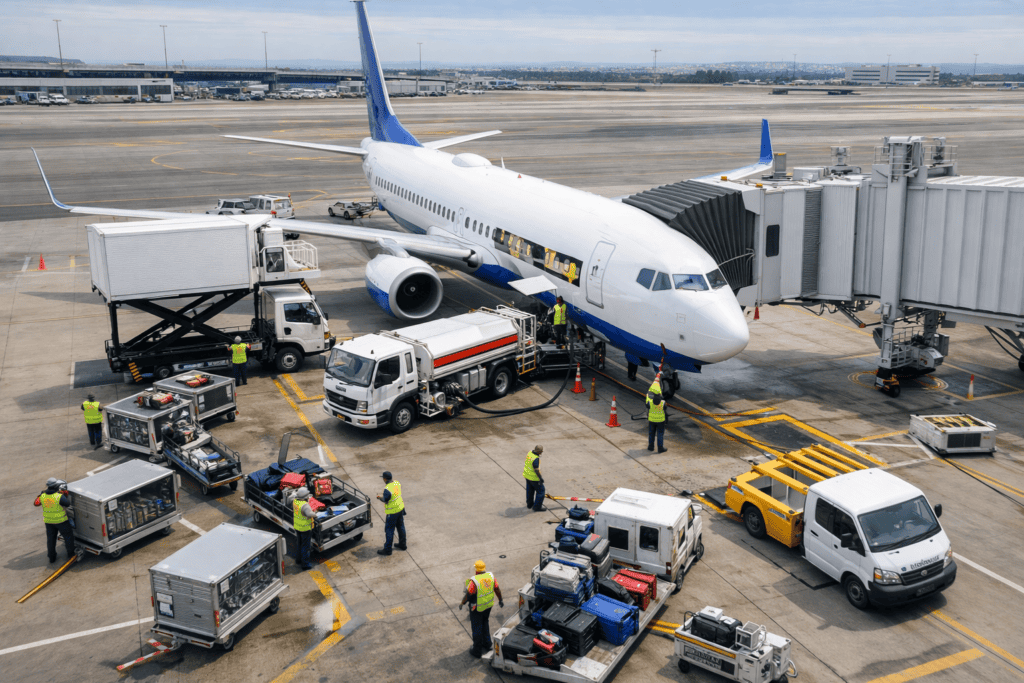
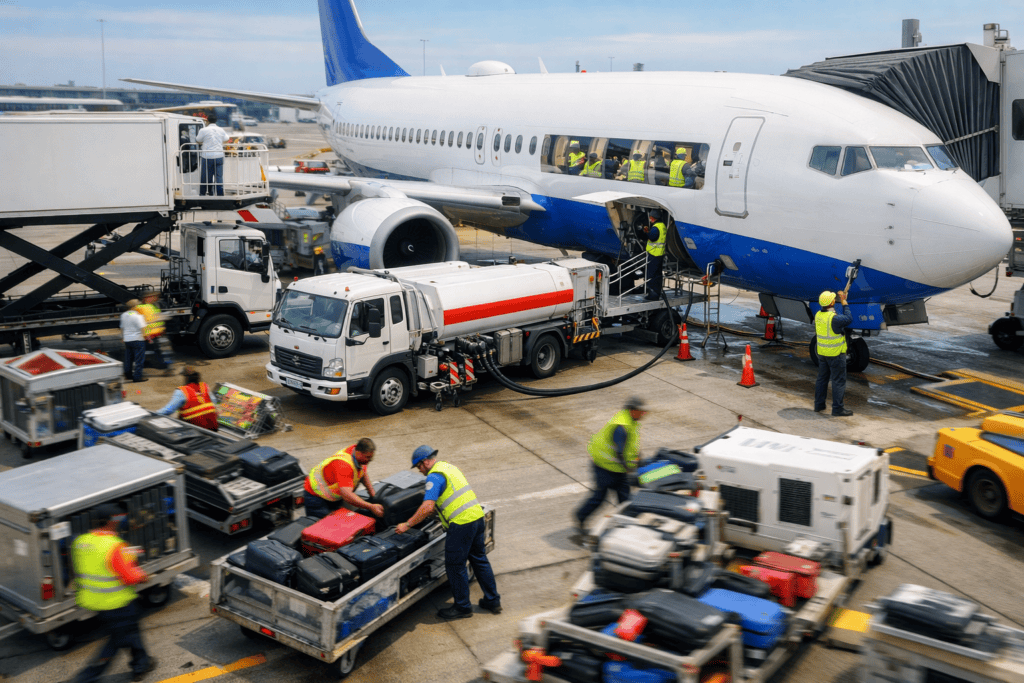
As passengers deplane, ground crews simultaneously unload baggage from the cargo hold. Baggage carts are positioned, baggage doors opened, and bags sorted according to destination. A large aircraft might have 200+ bags to unload. Baggage handlers work quickly but carefully—damage to baggage creates customer service problems and potential liability.
Baggage is unloaded onto carts, transported to baggage systems, and sorted for passengers to claim or for connection to other flights. If baggage is damaged, it’s documented and reported. Baggage unloading typically occurs simultaneously with passenger deplaning, minimizing overall turnaround time.
Aircraft Cleaning and Cabin Service (20-45 minutes)
While other crews work outside, cabin cleaning crews board the aircraft. They pick up trash, clean lavatories, wipe down tables and armrests, replace pillows and blankets, restock lavatories with supplies, and empty trash bins. For short flights, cleaning might take 20-30 minutes. International flights or flights with extended turnarounds receive deeper cleaning with floor cleaning, seat shampooing, and intensive sanitization.
Simultaneously, catering crews load meals, beverages, snacks, and other supplies for the upcoming flight. They load galley with the specific meals needed for the number of passengers and flight duration. They check previous flight inventory and remove items that are past expiration or damaged. For flights with full meal services, this can require significant time.
Fueling (15-30 minutes)
Fuel trucks connect to the aircraft and pump fuel appropriate for the next flight. The fuel required depends on the next flight’s distance, expected wind conditions, required reserve fuel, and current fuel remaining in tanks. Flight crew calculates fuel requirements accounting for all factors. Fuel trucks are positioned, connections made, and fuel pumped. Some turnarounds require defueling (removing excess fuel) if the next flight requires less fuel or weight needs to be reduced.
Fueling is typically done simultaneously with other turnaround tasks, minimizing time. However, fueling has safety requirements—only trained personnel handle fuel, specific procedures are followed, and smoking/fires are prohibited in fueling areas.
Maintenance Inspection
Depending on flight time and maintenance schedule, aircraft undergo inspections. Quick turnarounds might require only a visual exterior check. Longer turnarounds might require detailed inspections of engines, hydraulics, landing gear, and systems. Maintenance personnel conduct these inspections, document findings, and address any issues discovered. A landing gear concern, hydraulic leak, or engine problem identified during inspection might delay departure while repairs are completed.
Regular maintenance performed on turnaround schedules ensures aircraft remain in proper condition. Some maintenance is deferred (completed at overnight maintenance facilities) while urgent items are addressed immediately. Balancing safety requirements with schedule pressure is challenging during turnarounds.
Cargo Loading (variable time)
For cargo aircraft and passenger aircraft carrying cargo, cargo loading occurs during turnaround. Cargo from the previous destination is unloaded and sorted. Cargo for the next destination is loaded, respecting weight and balance requirements. Cargo documentation is verified, security inspections completed, and cargo doors closed.
Cargo aircraft turnarounds can be longer than passenger aircraft because cargo operations are often slower than passenger operations—cargo must be carefully loaded to respect weight limits, security inspections are more thorough, and documentation requirements are complex.
Final Preparations (5-10 minutes)
As the end of turnaround approaches, final preparations occur. Flight crew conducts exterior walk-around inspection, verifying no external damage and no foreign objects remain. Jet bridges are disconnected, ground vehicles are moved away, and the aircraft is powered up from auxiliary power units or main engines for flight departure. Flight crew conducts internal system checks. Boarding bridge operators monitor clearances.
Last-minute problems discovered in final preparations can delay departure—if an exterior inspection reveals damage, if systems don’t respond properly, or if mechanical issues are discovered, departure waits for investigation and repair.
Pushing Back and Taxiing
When all turnaround tasks are complete, the aircraft is ready for departure. A push-back tug connects to the aircraft nose gear and tows the aircraft backwards from the gate. Ground personnel ensure the area is clear, the tug is properly connected, and the push-back is conducted safely. Once clear of the gate, the tug disconnects and the aircraft powers up engines. For more on pushback procedures, see our detailed article on aircraft pushback procedures.
The aircraft taxis to the runway, coordinating with air traffic control. For more on how air traffic control manages airport ground operations, see our article on air traffic control procedures.
Factors Affecting Turnaround Time
Several factors influence how quickly turnarounds can be completed. Aircraft type matters—larger aircraft require more time to clean and service. Passenger count affects fueling, cargo loading, and cleaning time. Special requirements like hazardous waste disposal or extensive maintenance extend turnarounds. Equipment availability might delay turnarounds if fuel trucks or baggage equipment malfunction.
Weather affects turnarounds—heavy rain complicates external work, extreme heat increases fueling time, and winter weather creates icing and safety concerns. Gate availability affects when subsequent flights can be worked—if gates are full, new aircraft can’t park immediately. Previous flight delays or mechanical issues create cascading problems affecting subsequent turnarounds.
Experienced ground operations managers understand these factors and work to minimize turnaround time within safety and quality constraints.
Challenges and Pressures
Turnaround crews face intense pressure to work quickly while maintaining safety and quality. A 45-minute turnaround allows little time for problems—if fueling is delayed, cleaning can’t start until fueling finishes. If cleaning takes longer than expected, final inspections and pushback are delayed. One delayed task cascades through the entire schedule.
Ground crews work long hours in all weather conditions, often working physically demanding jobs (lifting baggage, standing in fuel areas, cleaning aircraft interiors). Fatigue can lead to mistakes. Pressure to meet schedules can tempt shortcuts that compromise safety or quality.
Conclusion
The aircraft turnaround is a critical operation requiring careful coordination between dozens of teams—passengers, cabin crew, ground handlers, fueling crews, maintenance personnel, catering, and airport operations. Understanding this process explains why certain operational decisions are made and appreciates the complexity underlying seemingly simple aircraft departures.
For more information on airport operations, see our guides on airport operations fundamentals, ground handling jobs, and aircraft safety procedures.
Sources & References
- International Air Transport Association – Ground Operations Standards
- Airlines Association – Operational Procedures
- Airport Operations Standards and Best Practices
Pingback: Airport Duty Manager Responsibilities (2026 Guide)
Pingback: Aircraft Turnaround Process Explained (Step-by-Step Guide)
Pingback: How Airports Handle Flight Delays (Full Guide 2026)