About the Author: Knight specializes in airport operations and airline scheduling. He explains how airports manage complex operational challenges including flight delays.
Introduction
Flight delays are frustrating for passengers, expensive for airlines, and operationally complex for airports. When a flight is delayed—whether due to mechanical issues, weather, maintenance, or other factors—airports must manage cascading impacts on other flights, passengers, crews, and aircraft. Understanding how airports handle delays provides insight into airport operations, explains why delays happen, and appreciates the coordination required to minimize impact.
Delays create ripple effects through airline schedules. A delayed inbound aircraft becomes the outbound aircraft for the next flight, now delayed as well. Crews scheduled for the delayed aircraft miss their next flights. Passengers miss connections. Ground equipment scheduled for other aircraft becomes unavailable. Managing these cascading impacts requires careful coordination and operational flexibility.

Types of Delays and Root Causes
Mechanical delays occur when aircraft systems malfunction requiring maintenance before departure. This might be a hydraulic leak, an instrument failure, or an engine problem. Maintenance personnel must inspect, diagnose, and repair the issue before the aircraft is safe to fly. Mechanical delays can range from 30 minutes to several hours depending on problem severity.
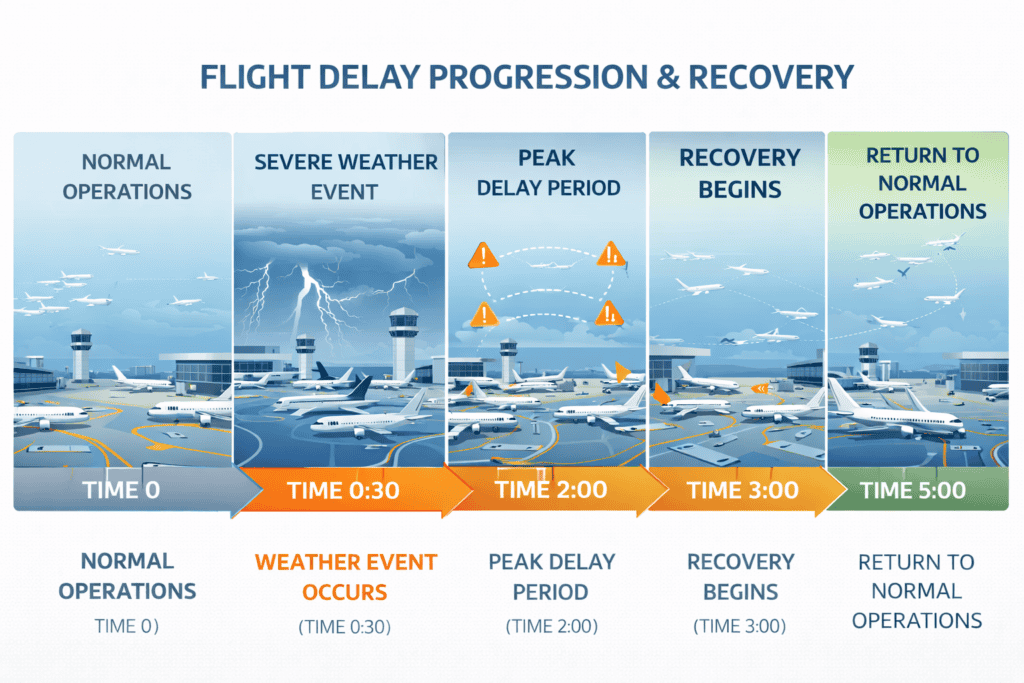
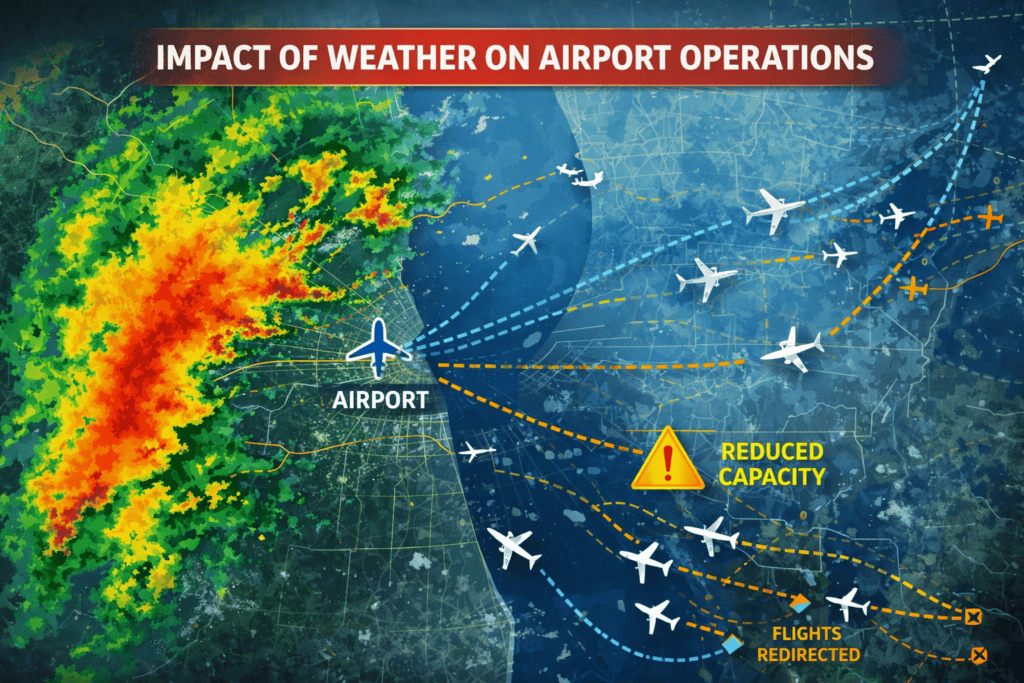
Weather delays result from conditions unsafe for flight—thunderstorms with lightning, extremely low visibility, icing conditions, or severe wind. Controllers might close runways when weather is severe. Aircraft on the ground can wait for weather to improve, or might divert to alternate airports. Weather delays can extend many hours if systems stall over an area.
Air traffic control (ATC) delays occur when ATC capacity is exceeded. During peak hours, particular airport/airspace combinations can only handle a certain number of aircraft departures per hour. When demand exceeds capacity, flights are held at the gate pending departure slots. Unexpected ATC equipment failures can reduce capacity, creating delays.
Crew delays occur when pilots, flight attendants, or ground crews are unavailable. Crew rest requirements might prevent flights departing if crews have exceeded legal working hours. Unexpected crew illnesses or crew scheduling errors can cause delays. Once crew scheduling issues are fixed, delays can clear rapidly.
Maintenance and turnaround delays occur when aircraft turnaround takes longer than expected. Extended cleaning, cargo loading, catering, or maintenance during the turnaround can delay departure. For more on turnaround procedures, see our article on aircraft turnaround process.
Gate delays occur when the departure gate is occupied by another aircraft or unavailable due to maintenance. Airport gate capacity limits flights that can depart simultaneously, creating gate bottlenecks during peak hours.
Supply chain delays occur when necessary equipment—cargo, fuel, catering—isn’t available when needed.
Airport Response to Delays
When delays occur, airport operations teams immediately assess impact and develop response strategies. Delay assessment determines the cause and estimated duration. Is the mechanical issue easily fixed (20 minutes) or complex (several hours)? Will the weather system move through in an hour or persist for six hours? Is the ATC delay expected to clear in 30 minutes or will it continue indefinitely?
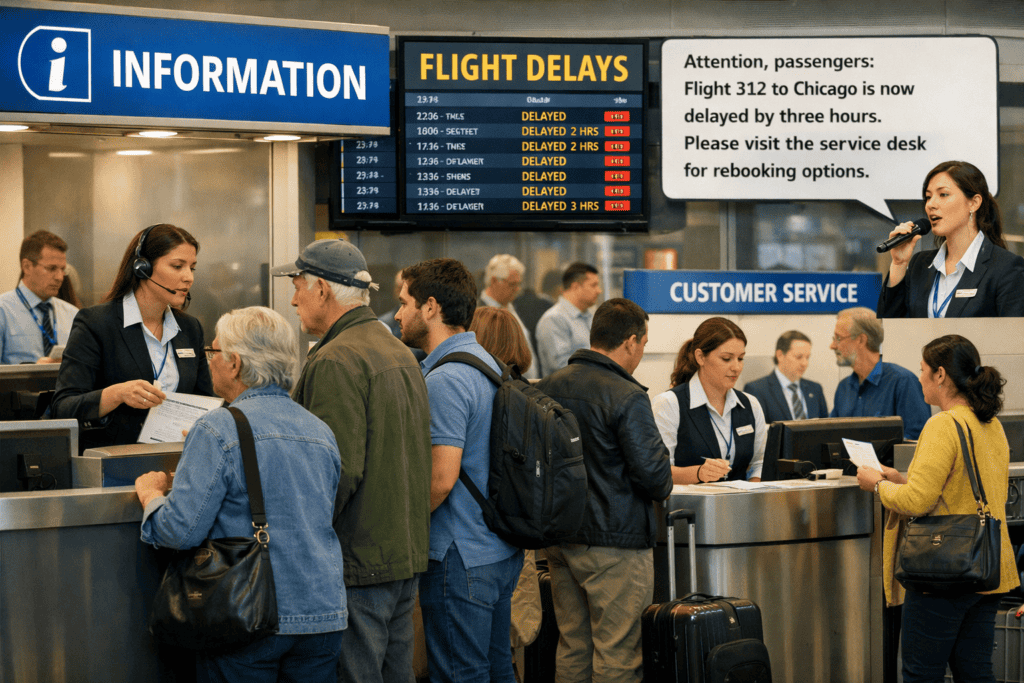
Crew management determines if crews will exceed legal rest requirements if the flight is delayed further. If so, replacement crews might be called. Passenger communication informs passengers of delays, reasons, and estimated new departure times. Rebooking offers passengers unable to wait alternative flights to their destinations.
Equipment reassignment assesses whether other aircraft can substitute if the delayed aircraft won’t be ready. Airlines might swap aircraft if one has mechanical issues but another is available. This might require equipment from another location, increasing costs. Gate management reassigns gates if the delayed aircraft’s gate is needed for other departures. Crew scheduling manages cascading crew effects—crews scheduled for the delayed aircraft’s next flight must be rescheduled, crews for flights that will now depart earlier must move up, etc.
Operational Coordination During Delays
Ground operations stands ready to adapt. If an aircraft returns to the gate due to mechanical issues, maintenance personnel are already standing by. If a replacement aircraft is assigned, ground crews are mobilized to prepare that aircraft for passengers and cargo.
Air traffic control coordinates ground delays with airborne traffic. If a flight can’t depart due to mechanical delay, ATC is informed immediately, clearing that departure slot for other flights. Controllers might resequence other flights to optimize traffic flow despite the delay.
Airline operations centers monitor delays system-wide. Major airlines have command centers coordinating fleet movements, crew scheduling, passenger rebooking, and overall operations. When one flight delays, operations centers assess impact on other flights and adjust as needed.
Passenger services manages passenger experience during delays. Gate agents provide information, assist with rebooking, coordinate meal vouchers for extended delays, and manage passenger frustration professionally.
Managing Cascading Delays
A single delayed flight creates cascading effects. If Flight A (using aircraft X) is delayed two hours, that aircraft becomes late for Flight B (its next assignment). Flight B now departs two hours late. If Flight B was arriving from cross-country, Flight C (using that aircraft) is now delayed as a result. One initial delay can affect dozens of flights as aircraft, crews, and slots cascade through the schedule.
Airlines manage cascading delays by swapping equipment (assigning different aircraft to flights), rescheduling crews (assigning crews to different flights), extending turnaround windows (if delays are expected), and holding aircraft in reserve (keeping extra aircraft available for emergencies and delays).
Weather-Related Delay Management
Weather delays are particularly challenging because weather predictions have uncertainty. Is a thunderstorm system moving through in two hours or will it stall for six hours? Airlines must decide whether to wait or divert. Diversion to alternate airports adds costs (landing fees, passenger transportation, crew legal issues if crews exceed hours), but prevents waiting at the original airport indefinitely.
Airport operations work with airline operations centers, providing weather updates and forecasts. As weather systems move, airports can often increase operations without waiting for complete clearing. A brief window in thunderstorm activity might allow a flight departure; airports and airlines coordinate to take advantage of these windows.
For information on how air traffic control manages weather situations, see our article on air traffic control procedures.
Mechanical Delay Resolution
Mechanical delays require diagnosis and repair. Maintenance personnel determine the problem, obtain parts if necessary, complete repairs, and ground test aircraft systems before sign-off. Some issues are simple (an overhead bin latch fails—replaced in 20 minutes) while others are complex (engine oil pressure problem requiring partial engine disassembly—requires hours).
Availability of spare parts affects repair time. If parts are in stock, repairs proceed quickly. If parts must be brought from another location, delays extend. Major airlines maintain supply chains specifically to minimize parts acquisition time. Depot maintenance facilities with large parts inventory provide rapid repair capability.
Passenger Impacts and Compensation
Extended delays create passenger frustration, missed connections, and regulatory compensation requirements. In the United States, airlines typically provide meal vouchers for extended delays, complimentary phone calls, and gate hold rules (airlines must hold flights to wait for connecting passengers). In Europe, passenger rights regulations require airlines to provide compensation ($200-600 depending on delay length) for delays exceeding certain durations.
Airlines manage passenger impacts by offering rebooking to other flights, accommodating overnight hotel stays if necessary, and providing transportation. Customer satisfaction during delays affects airline reputation and future bookings.
Conclusion
Flight delays are inevitable in complex aviation operations. Airports and airlines manage delays through careful assessment, rapid decision-making, and operational flexibility. Coordinating equipment, crews, gates, passengers, and services while delays cascade through schedules requires professional operations teams and proven procedures. The next time you experience a flight delay, understand that significant effort is being applied behind the scenes to minimize impact and restore operations.
For more information on airport operations, see our guides on airport operations fundamentals, aircraft turnaround process, and air traffic control.
Sources & References
- FAA Delay Reporting and Analysis Systems
- Department of Transportation – Flight Delays Data
- Airline Operations Standards