About the Author: Knight is an aviation professional with extensive experience in airport operations and aviation career development. He specializes in helping aspiring aviation professionals understand career paths, salary expectations, and advancement opportunities. His expertise comes from working directly with aviation employers and industry professionals. Kinght’s mission is to make complex aviation career information accessible to everyone interested in the aviation industry.
Introduction
Before an aircraft can taxi to the runway, it must first move backward—away from the gate and out into the taxiway. This seemingly simple movement is the aircraft pushback, a carefully choreographed procedure coordinated between pilots, ground crews, and air traffic control. While passengers often don’t notice the pushback, it’s a critical safety procedure with specific requirements, communication sequences, and equipment needs.
Understanding pushback procedures explains why pilots call for pushback clearance, explains the coordination between ground crews and pilots, and demonstrates the procedures ensuring safe movement of expensive, large aircraft in busy airport areas. For context on aircraft turnaround operations, see our article on aircraft turnaround process.
What is Aircraft Pushback?
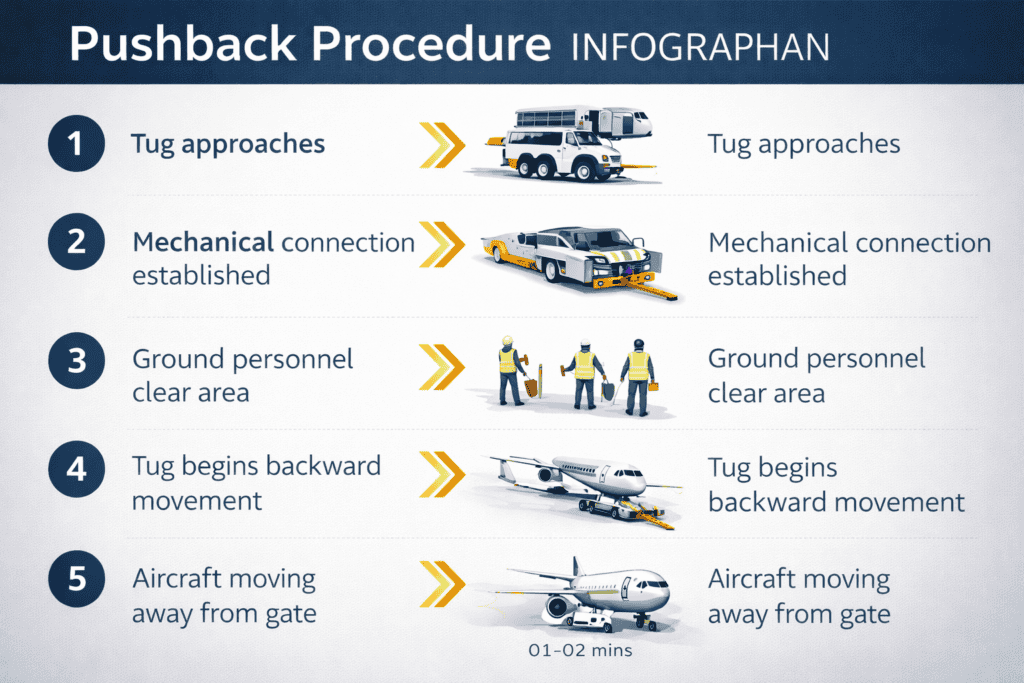
Pushback is the process of towing an aircraft backward from the gate using a specially designed tow vehicle called a pushback tug (or pushback tractor). Aircraft cannot safely drive backward under their own power—the jet engines would point toward the terminal, creating safety hazards. Therefore, specialized tugs are used to mechanically tow aircraft backward away from gates.
Pushback Equipment: The Tug
The pushback tug is a specialized vehicle designed specifically for towing large aircraft. Modern tugs have mechanical connections to the aircraft’s nose gear—not the main gear—ensuring the aircraft can be towed safely without excessive strain. The tug has sufficient power to tow 200-ton+ aircraft safely and sufficient size to maintain safe operation near the terminal.
Tugs must be operated by trained personnel holding special certifications. Ground handling companies employ tug operators trained in safe towing procedures, communicating with pilots, and responding to unexpected situations. For information on ground handling careers, see our guide on ground handling jobs.
Pre-Pushback Coordination
Before the tug tows the aircraft, pilots and ground crews coordinate carefully. The tug driver communicates via radio with the flight crew—”tug is ready to connect, request permission to proceed.” The captain (pilot-in-command) verifies that all systems are configured for pushback—landing gear down, flaps set appropriately, flight control surfaces are free to move. Only after confirming everything is ready does the captain clear the tug to proceed.
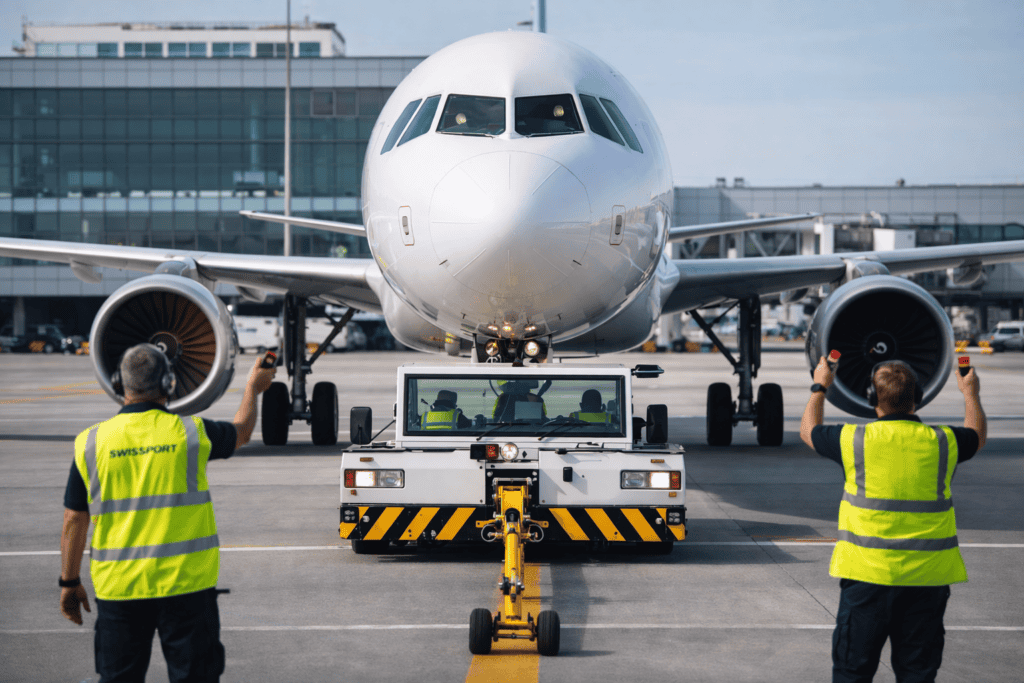
The tug driver approaches the nose gear slowly and carefully, connecting to the aircraft’s nose gear tow receptacle. This connection must be made precisely—if the connection is off-center, the aircraft will be pulled sideways. Modern tugs have video camera systems allowing drivers to see the nose gear clearly, facilitating safe connection.
Air Traffic Control Clearance
Before the tug actually begins towing, the ground controller (who controls aircraft movements on the airport ground) must issue pushback clearance. Ground control is consulted—”requesting pushback from gate [number].” The ground controller verifies that the requested pushback won’t conflict with other aircraft, vehicles, or facilities. Only after confirming the area is clear does the controller issue “pushback approved, caution equipment and buildings on the right side, north side has light traffic.”
The pilot relays this clearance to the tug driver: “pushback approved, equipment right side, light traffic north.” This communication ensures both pilots and tug driver understand the clearance and the specific cautions for this particular pushback.
The Actual Pushback Procedure
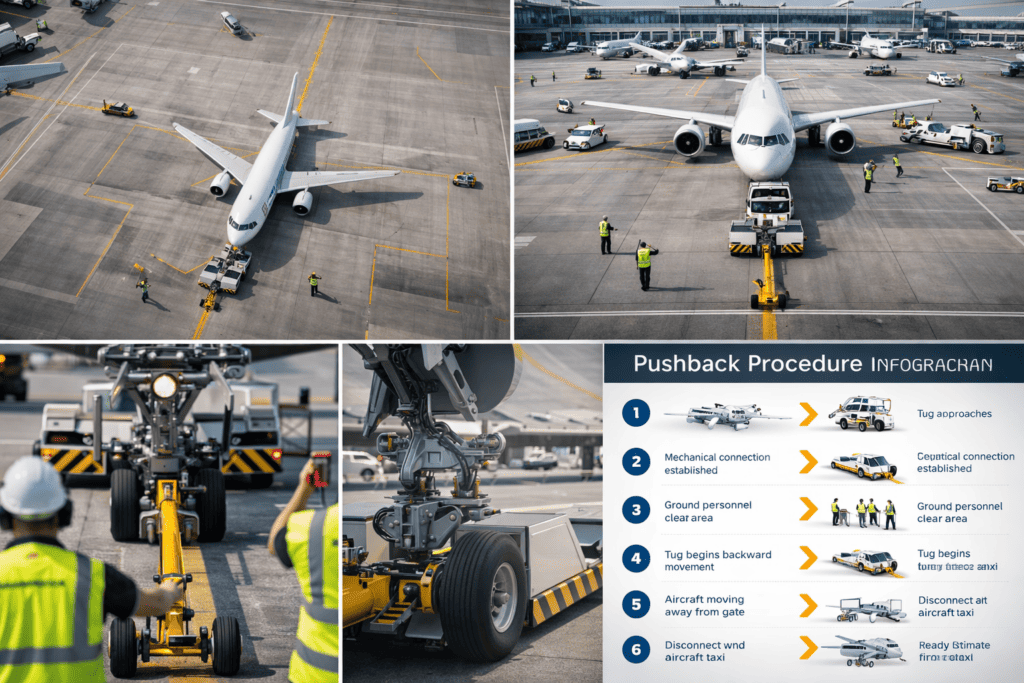
Once clearance is issued and the connection is confirmed, the tug driver slowly begins towing, pulling the aircraft backward away from the gate. The process is slow and careful—typical pushback speeds are only a few miles per hour, allowing immediate stopping if problems arise. The pilot watches the wingtips and tail to ensure adequate clearance from terminal buildings and other aircraft.
Ground crews position themselves with visual contact on the aircraft, monitoring the pushback. If obstacles are closer than expected or if the aircraft doesn’t move as anticipated, ground crews signal the tug driver to stop. The pilot and tug driver remain in constant radio communication—”continue pushing,” “stop pushing,” “connected but aircraft not moving (might indicate connection problem).”
Once the aircraft is sufficiently clear of the gate and other equipment, the pushback is complete. The tug driver then either tows the aircraft to a staging area to await runway clearance or disconnects on the spot. After disconnection, the tug driver confirms the disconnection, ensuring the nose gear is free and the tug can safely drive away.
Safety Considerations
Several safety factors make pushback critical to manage carefully. The aircraft is still parked near the terminal with power typically provided by ground power units rather than engines—pilots cannot move the aircraft independently during pushback. The surrounding area might have ground vehicles, equipment, ground personnel, and passengers—insufficient clearance could create collisions or hit people.
Modern aircraft have nose cameras allowing pilots to see the nose gear area during connection. Ground personnel, called “wing walkers,” monitor clearance on both wingtips during pushback. Wing walkers maintain visual contact with the tug driver via radio, alerting if obstacles develop. These procedures ensure safe pushback even in tight areas.
Problems During Pushback
Sometimes pushback encounters problems. Connection failure—the tug can’t properly connect to the nose gear—requires troubleshooting. Equipment failure—the tug engine fails, power steering fails—requires a different tug to be called. Aircraft system problems—pilots discover issues during pushback and call for a stop—require resolution before continuing.
If the aircraft nose gear is damaged during connection (extremely rare with modern procedures), the aircraft must return to the gate for inspection and possible repair. These scenarios create delays, but safety overrides schedule pressure.
Modern Innovations
Some newer airports are implementing “tow-less” or “power push-back” procedures where aircraft engines provide limited power allowing aircraft to reverse themselves without tugs. However, this requires specialized training and careful procedure to ensure safety. Most airports continue using tugs, which remains the most reliable, safest method.
Conclusion
Aircraft pushback is a carefully choreographed procedure involving pilots, ground crews, air traffic control, and specialized equipment. The procedure ensures safe movement of large aircraft in crowded airport areas while maintaining safety for people and equipment nearby. Understanding pushback procedures explains an important element of airport operations that passengers often don’t notice but is essential to safe aircraft movement.
For more information on airport ground operations, see our guides on airport operations fundamentals, aircraft turnaround process, and ground handling jobs.
Sources & References
- FAA Ground Operations Standards
- Aircraft Manufacturers’ Operating Procedures
- Ground Handling Services Standards