About the Author: Knight is an aviation professional with extensive experience in airport operations and aviation career development. He specializes in helping aspiring aviation professionals understand career paths, salary expectations, and advancement opportunities. His expertise comes from working directly with aviation employers and industry professionals. Kinght’s mission is to make complex aviation career information accessible to everyone interested in the aviation industry.
Choosing a career in aviation is exciting but overwhelming. With dozens of
potential paths, each requiring different skills, education, and commitment,
how do you know which career is right for you?
This comprehensive guide walks you through the decision-making process, helping
you evaluate aviation careers based on your values, personality, and lifestyle
goals.
Step 1: Assess Your Priorities
Before researching specific careers, understand what matters most to you.
Different aviation careers offer very different lifestyles.
Work-Life Balance
Do you want to work 9-5 or are you comfortable with irregular schedules? This
decision dramatically affects your quality of life.
Pilots work irregular hours and travel constantly. Airport managers work standard
hours in one location. Air traffic controllers work shifts but have stability.
Understanding your preferences helps narrow options significantly.
Income Timeline
Are you willing to start at $30K and work toward $200K+ over 15 years? Or do
you prefer reaching $100K+ within 5 years?
Pilots take longer to reach peak salary. Controllers reach good income faster.
This matters tremendously for financial planning and motivation.
Education Investment
How much time and money are you willing to invest upfront?
Pilot training costs $150K+ and takes years. Air traffic control training is
government-funded with lower upfront costs.
Travel Requirement
Do you love traveling, or do you prefer staying home?
Pilots travel constantly. Ground-based roles keep you in one location.
Stress Level
Can you handle high-stress decisions affecting safety?
Controllers manage stress of coordinating aircraft. Mechanics focus on technical
work with lower pressure.
Answer these honestly. Your answers determine which careers fit your life.
Step 2: Research Actual Job Duties
Most people decide on aviation careers based on salary or status, not actual
job duties. This is a big mistake.
Understanding what you actually do daily matters more than the paycheck.
Interview Someone in the Role
For each career you’re considering, interview someone currently in that role.
Ask them:
- What’s a typical day like?
- What’s the hardest part?
- What surprised you about the job?
- Would you choose this career again?
- What’s the work-life balance really like?
Read Job Descriptions Carefully
Note the daily responsibilities:
- What do you actually do each day?
- What’s the work schedule (hours, shifts, travel)?
- What are the physical demands?
- What are the mental demands?
- How much decision-making is involved?
- How large is your team?
Observe if Possible
Spend time observing if you can. Visit an airport control tower (if access
allowed). Watch mechanics at work. Shadow a manager for a day.
This honest assessment prevents costly mistakes. Many people start pilot training
and quit halfway because they realize they don’t actually want to fly.
Step 3: Evaluate Education Requirements
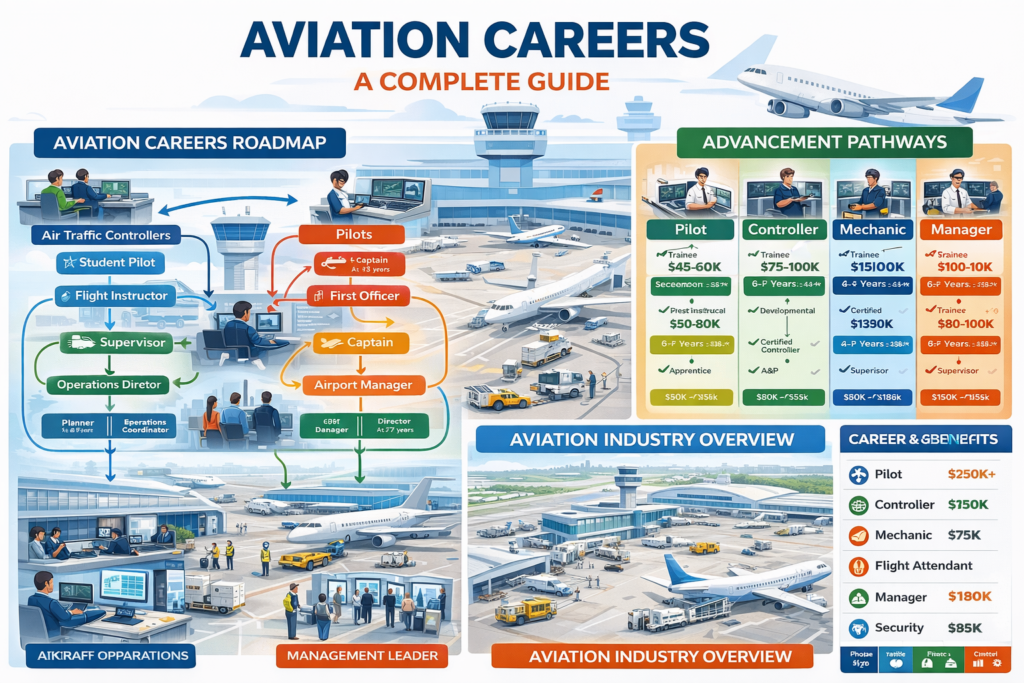
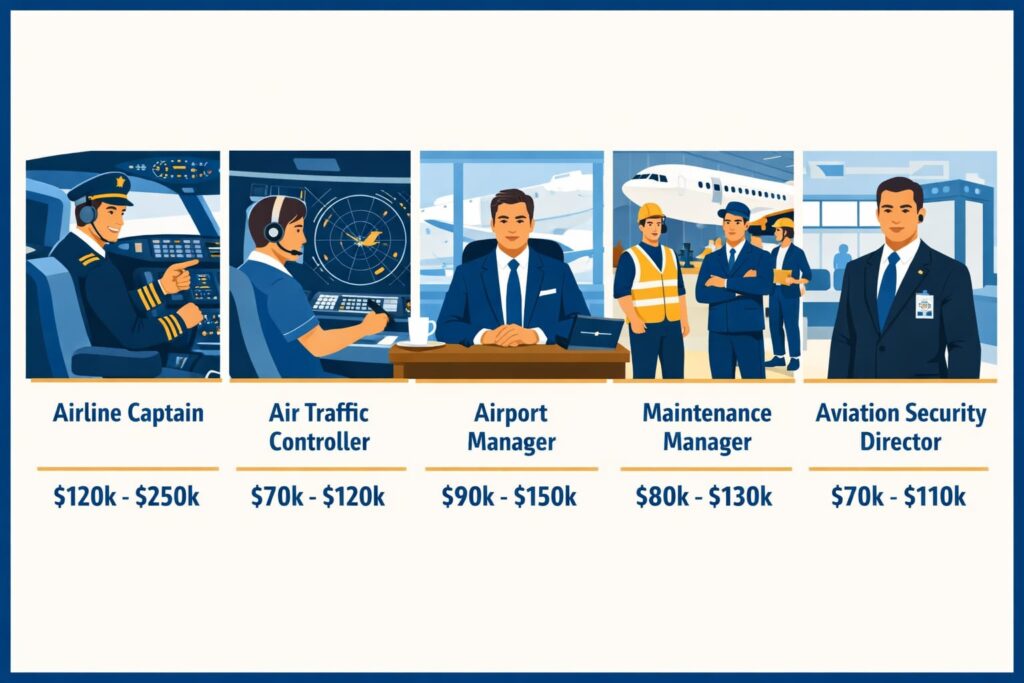
Different aviation careers have vastly different education paths.
Airline Pilot
- Training time: 6-8 years
- Cost: $150K-$200K
- Starting salary: $30K-$50K
- Peak salary: $200K-$300K
Air Traffic Controller
- Training time: 3-4 years
- Cost: $0 (government-funded)
- Starting salary: $60K-$80K
- Peak salary: $120K-$150K
- Read More About ATC
Aircraft Mechanic
- Training time: 2-4 years
- Cost: $20K-$50K
- Starting salary: $40K-$60K
- Peak salary: $80K-$120K
Airport Manager
- Training time: 4 years college + experience
- Cost: $30K-$60K
- Starting salary: $50K-$70K
- Peak salary: $180K-$250K
- Read more about airport manager
Choose based on how long you’re willing to invest, how much upfront cost you
can afford, how soon you need income, and your long-term salary goals.
Step 4: Consider Your Personality
Aviation careers suit different personality types.
Detail-Oriented / Procedural Thinkers
Mechanics, Controllers, Compliance Officers suit this personality type. These
roles require exact adherence to procedures. One mistake equals serious safety
issues. If you love detailed work and following processes, these suit you.
Decision-Makers Under Pressure
Pilots, Managers, Operations Coordinators suit this type. These roles require
quick decisions with limited information. If you thrive under pressure and make
confident decisions, these suit you.
Problem-Solvers
Engineers, Maintenance Supervisors, Safety Officers fit here. These roles focus
on finding issues and creating solutions. If you enjoy troubleshooting and
improving systems, these suit you.
People-Focused
Customer Service, HR, Training, and Management roles. These require strong
interpersonal skills. If you love leading, teaching, or helping people, these
suit you.
Technical / Hands-On
Mechanics, Technicians, Ground Operations. These roles involve working with your
hands on physical systems. If you prefer hands-on work over desk work, these
suit you.
Be honest about your personality. Forcing yourself into the wrong personality fit
creates misery.
Step 5: Compare Your Top 3 Choices
Create a comparison chart of your top options to see trade-offs clearly.
| Criteria | Career A | Career B | Career C |
|---|---|---|---|
| Training Time | |||
| Salary Year 1 | |||
| Salary Year 10 | |||
| Travel Required | |||
| Work Hours | |||
| Stress Level | |||
| Job Growth | |||
| Job Security | |||
| Work-Life Balance |
This visual comparison helps tremendously.
Step 6: Make Your Decision
After research and evaluation, you should have clarity.
Some careers might be off the table: “I don’t want to travel constantly, so
pilot isn’t right for me.”
Others become clear winners: “Air traffic controller offers salary in 5 years
AND good work-life balance.”
Trust your research. Your honest assessment matters more than external pressure.
Final Advice
Choosing an aviation career is personal. What’s perfect for someone else might
be wrong for you.
Take time to evaluate thoroughly. Better to spend weeks researching than years
regretting a wrong choice.
If you’re struggling to decide, consider:
- Talking to career counselors
- Taking aviation career aptitude tests
- Starting in entry-level roles to test your fit
- Volunteering in different aviation areas
Your career is too important to choose casually. Choose thoughtfully, commit
fully, and you’ll find fulfillment.